
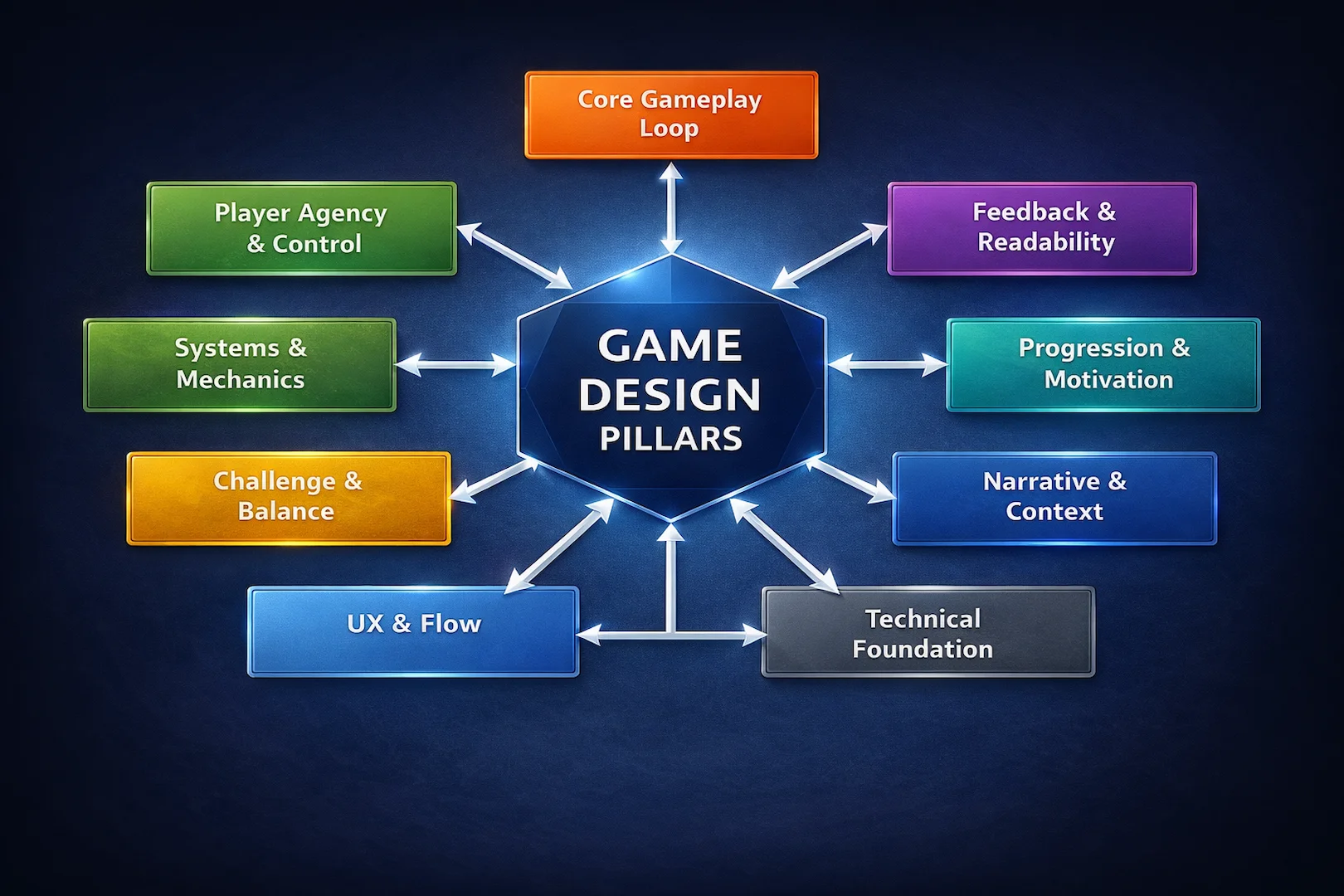
Game design is not inspiration, nor an aesthetic opinion. It isn’t a “good idea,” nor a nice concept on paper. It’s the structural architecture on which every game is built. It’s the sum of decisions that define what the player does, why they do it, how they understand it, and whether they ultimately have a reason to keep going. In practice, game design functions as a large system of subsystems, grounded on specific game design pillars. It defines rules, constraints, flows, consequences, and cause-and-effect relationships. It doesn’t care whether something is “beautiful,” but whether it works, whether it communicates correctly, and whether it produces a coherent experience. When game design fails, the result isn’t simply a boring game, but a game that exhausts, confuses, or collapses mechanically.
To be clear and absolutely accurate, game design doesn’t need to do everything. It is not a substitute for technology, narrative, animation, or audio. Its role is not to “save” problems in other disciplines. On the contrary, its role is to organize, coordinate, and give meaning to all of these, so they serve a common purpose: the player experience.
A complete game doesn’t happen because everything is simply present. It happens when the core foundations of design are correctly structured and operate in balance. These foundations are not infinite, nor arbitrary. They are specific, recognizable axes that appear again and again in theory, in industry, and in practice, regardless of genre, budget, or platform. This approach is also reflected in theoretical frameworks such as MDA (Mechanics–Dynamics–Aesthetics), which are widely used in game analysis and design.
In this article, we will analyze the core pillars of game design. The areas without which a game begins to “hurt” in specific places, even if everything else looks fine. For each pillar, we will explain what it is, what it addresses, what it consists of, what purpose it serves, what impact it has on gameplay, and—equally important—what it does not do. Because in game design, clarity is often more critical than complexity.
The 9 Core Pillars of Game Design
Pillar 1 – Core Gameplay Loop
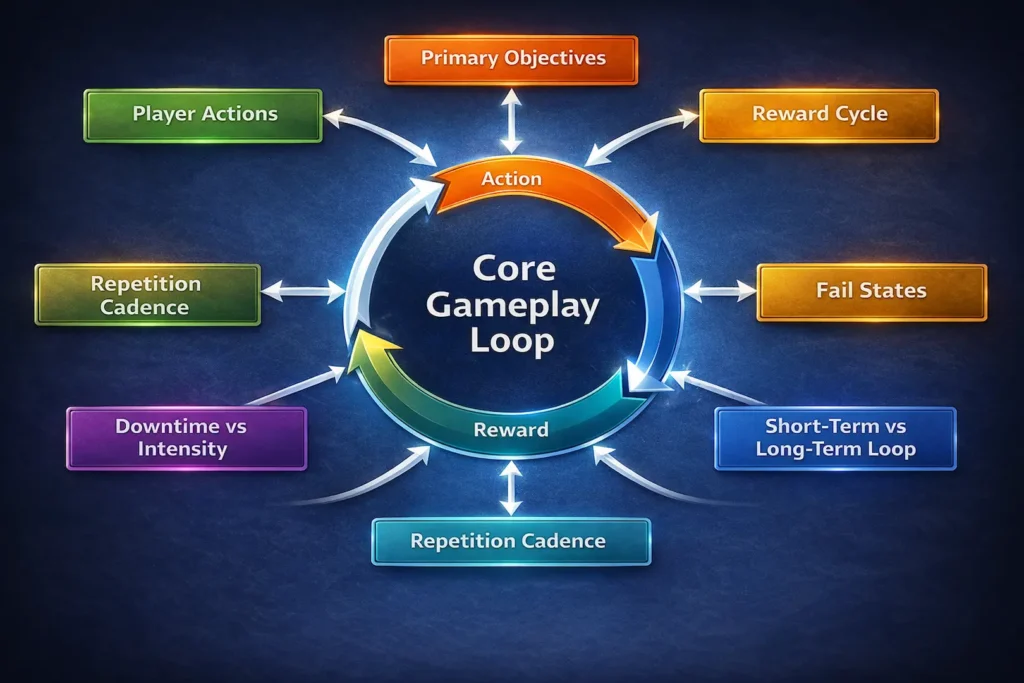
The first of the core pillars of game design is the Core Gameplay Loop. It is the fundamental, repeatable cycle of actions the player performs throughout a game. It is the foundational answer to the question: what does the player keep doing, and why should they keep doing it? It is not about isolated moments or impressive set pieces, but about the structure of the day-to-day gameplay experience.
In every game, regardless of genre or scale, such a loop exists. It can be simple or complex, fast or slow, but it is always present. When a player plays for hours, they are essentially playing inside that loop.
What It Addresses
The Core Gameplay Loop pillar addresses how the player interacts with the game over time. It defines the pacing, flow, and coherence of the experience. It is the mechanism that connects action to outcome, effort to reward.
A clear, well-designed loop allows the player to understand what is happening without the game explicitly explaining it. By contrast, a vague or poorly designed loop creates confusion and fragmentation, even if the individual systems are well built.
What It Consists Of
Although it functions as a single whole, the Core Gameplay Loop is built from specific design components:
- basic player actions (player actions)
- immediate short-scale goals (primary objectives)
- reward cycle (reward cycle)
- fail states and restart conditions (fail states)
- the repetition cadence of the loop (repetition cadence)
- distinction between short-term and long-term loops (short-term vs long-term loop)
- alternation between intensity and downtime (downtime vs intensity)
These elements do not operate independently. Their value emerges from how they connect and repeat.
Its Purpose
The purpose of the Core Gameplay Loop is not simply to “keep” the player busy. It is to create meaning through repetition. Through the loop, the player learns, improves, develops expectations, and understands the rules of the world.
A successful loop trains the player organically. It does not rely on tutorials or explanations, but on the natural flow of gameplay. The player understands what works and what doesn’t because they experience it.
Its Impact on the Game
The Core Gameplay Loop directly affects pacing, engagement duration, and the overall sense of coherence. It is the reason two games with similar features can feel radically different to play.
When the loop is well designed, the game “flows.” When it is weak, the player starts to feel like they are repeating actions without purpose, even if the content changes.
What It Does
This pillar gives structure to the experience. It connects systems, defines where the player’s time is invested, and serves as the base on which progression, challenge, and narrative lock in. It is the frame within which everything else gains functional purpose.
What It Does Not Do
The Core Gameplay Loop does not guarantee depth on its own. It does not replace systems, it does not create variety unless supported, and it is not directly tied to narrative or aesthetics. Its role is strictly structural. If it is forced to carry more responsibilities, it will simply collapse.
When It’s Missing or Underperforming
When the Core Gameplay Loop is unclear or problematic, the game begins to cause fatigue very early. The player struggles to understand what they are pursuing, the experience feels disjointed, and the “solution” is often mistakenly sought in more content or superficial incentives.
In reality, the problem is structural. Things aren’t missing. The correct cycle that binds them is.
Pillar 2 – Player Agency & Control
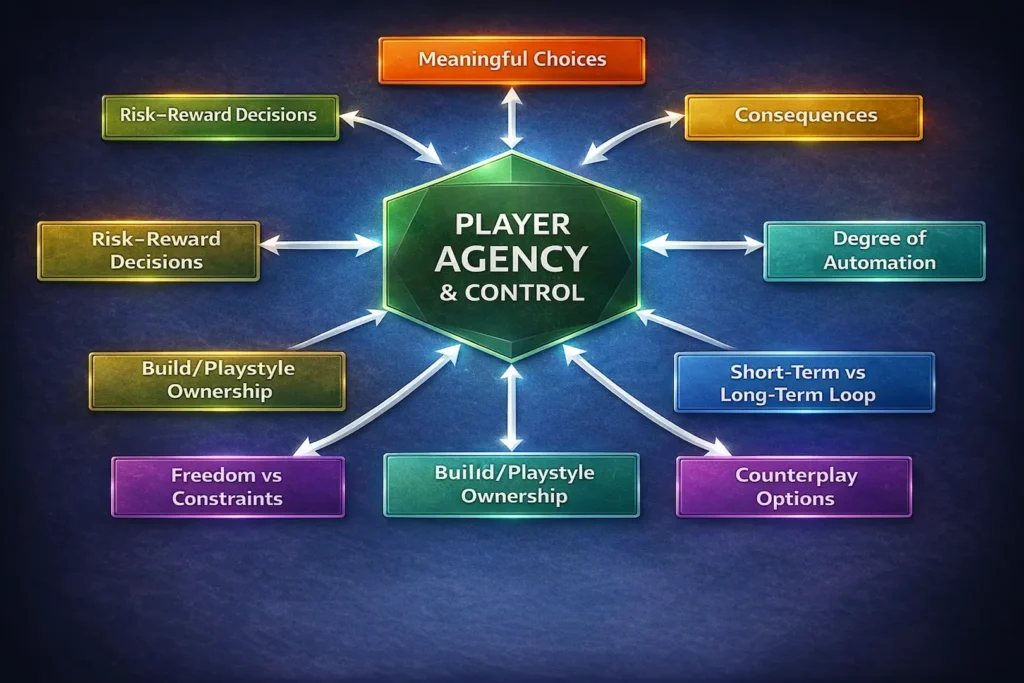
The Player Agency & Control pillar concerns the degree to which the player has meaningful influence over what happens in the game, and the degree to which their actions translate directly and reliably into outcomes. We are not simply talking about whether the player “presses buttons,” but whether their choices have weight, direction, and consequences.
Player agency means the player is not a spectator inside a system that evolves on its own. Control means the game respects the player’s intent and does not arbitrarily intervene between input and result.
What It Addresses
This pillar addresses the responsibility relationship between player and game. It determines whether the player feels they succeeded because they played well, or failed because they made a mistake—not because the game decided something on their behalf.
Here we evaluate concepts such as freedom of choice, sense of control, fair outcome attribution, and whether the game allows the player to develop a personal gameplay approach. When this pillar functions properly, the player feels like a co-author of the experience.
What It Consists Of
The Player Agency & Control pillar is formed by specific design components that determine how “yours” the way the game plays actually is:
- meaningful choices with real impact (meaningful choices)
- consequences that stem from player decisions (consequences)
- immediate and reliable response to inputs (input responsiveness)
- degree of automation and system intervention (degree of automation)
- risk–reward decisions (risk–reward decisions)
- balance between freedom and constraints (freedom vs constraints)
- build / playstyle ownership (build / playstyle ownership)
- counterplay options (counterplay options)
These elements do not merely increase complexity. They determine whether gameplay feels personal or impersonal.
Its Purpose
The purpose of Player Agency & Control is to ensure the player plays consciously. That their decisions matter, and that outcomes reflect their choices and skill.
The presence or absence of this pillar directly affects how difficulty, progression, and replayability are experienced. Games with low agency can be impressive, but rarely create deep engagement, because the player feels easily replaceable.
A game with strong agency allows multiple approaches to the same problem and respects player-derived solutions, even if they are not the “intended” ones. It does not constantly guide the player, but trusts them.
Its Impact on the Game
By contrast, when agency is strong, even simple systems gain depth, because the weight shifts from what the game “offers” to how the player chooses to handle it.
What It Does
The Player Agency & Control pillar:
- gives meaning to choices
- shifts responsibility to the player
- enables personal playstyle development
- strengthens the link between effort and outcome
It is why the player says “I lost because I made a mistake,” not “I lost because… whatever.”
What It Does Not Do
It does not guarantee balance, it does not replace challenge design, and it does not mean absolute freedom. A game can have strict constraints and still have high agency, if the choices within those constraints are meaningful.
It also does not directly relate to complexity. More choices do not automatically mean more agency if they all lead to the same outcome.
When It’s Missing or Underperforming
When Player Agency & Control is weak, the game starts to feel “automatic.” Successes don’t satisfy, and failures enrage, because the player doesn’t recognize themselves in the outcome.
In these cases, the problem is not that the player lacks choices. It’s that their choices don’t matter.
Pillar 3 – Systems & Mechanics
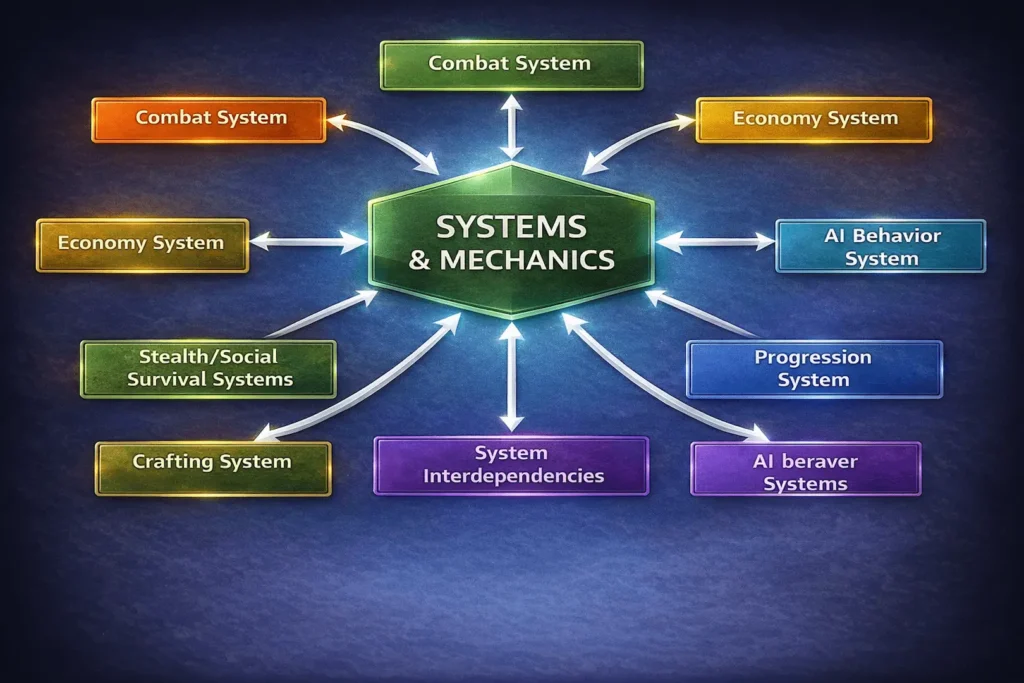
Continuing with the pillars of game design, we reach Systems & Mechanics. This pillar concerns the rules that govern the game’s world and how those rules interact with one another. It is the point where the game stops being a sequence of scripted situations and becomes a functional system.
Mechanics are the core rules and actions. Systems are their organized connection into a whole that produces behavior. A game without systems can work momentarily. A game with systems can work over time.
What It Addresses
This pillar addresses how the game “works” beneath the surface. How states emerge, how the world reacts to the player’s actions, and how different subsystems influence one another.
This is where emergent gameplay is born—not because the game predicts it, but because the systems are clear and consistent enough to produce unexpected yet logical outcomes.
What It Consists Of
The Systems & Mechanics pillar is composed of subsystems that run simultaneously and interact:
- combat system (combat system)
- traversal and navigation system (traversal system)
- economy and resource system (economy system)
- AI behavior system (AI behavior system)
- progression and character development system (progression system)
- crafting or construction system (crafting system)
- stealth, social, or survival systems where applicable (stealth / social / survival systems)
- system interdependencies (system interdependencies)
Their value is not in quantity, but in coherence and interaction.
Its Purpose
The purpose of this pillar is to create a world that reacts. To ensure player actions are not treated in isolation, but affect multiple layers of gameplay.
A well-designed system allows the player to experiment, combine mechanics, and find solutions that were not strictly predefined. It does not lead the player by the hand. It gives them tools and rules.
Its Impact on the Game
Systems determine depth and longevity. They are why a game can remain interesting even when the player understands all the core mechanics.
When systems are shallow or isolated, gameplay is exhausted quickly. When systems are interconnected and understandable, every new situation feels fresh, even if it emerges from familiar rules.
What It Does
The Systems & Mechanics pillar:
- creates world consistency
- enables emergent situations
- provides tools instead of scripted solutions
- turns gameplay into a problem to solve
It is the foundation of strategy, adaptability, and player creativity.
What It Does Not Do
It does not guarantee fun by itself. More systems do not mean a better game. It also does not replace pacing design or feedback clarity. A complex system that isn’t communicated clearly just confuses.
Its role is to provide depth, not surface-level spectacle.
When It’s Missing or Underperforming
When Systems & Mechanics are weak, the game relies excessively on scripted moments and predetermined solutions. The player feels like they are “doing what they’re supposed to do” instead of thinking.
In these cases, the problem is not a lack of content. It’s that the world does not function as a system, but as a backdrop.
Pillar 4 – Challenge & Balance
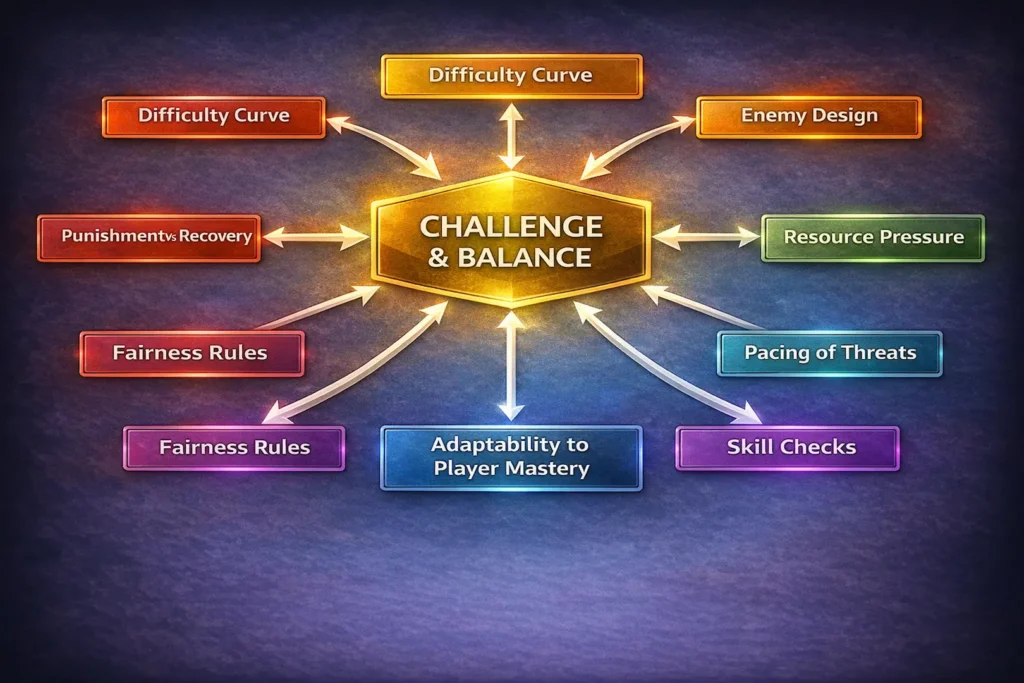
Continuing with the core pillars of game design, we encounter Challenge & Balance, which concerns how the game tests the player and how that test scales over time. We are not simply talking about “difficulty,” but whether the game presents problems that are understandable, fair, and solvable with the tools it provides.
Challenge is the obstacle the player must overcome. Balance is the internal equilibrium that determines whether that obstacle is reasonable at that moment. One without the other collapses.
What It Addresses
This pillar addresses the relationship between skill and demand. It determines when the player is pushed, when they feel progress, and when they fail. Here we decide whether failure becomes a lesson or a punishment, and whether success feels like the result of skill or luck.
Challenge & Balance is tightly linked to pacing, learning, and player psychology. Poorly tuned challenge doesn’t merely discourage. It destroys the player’s trust in the game.
What It Consists Of
Challenge & Balance is structured by design components that determine how and when difficulty is applied:
- difficulty curve and challenge escalation (difficulty curve)
- enemy / obstacle design (enemy / obstacle design)
- resource pressure and constraints (resource pressure)
- threat pacing (threat pacing)
- fairness and consistency rules (fairness rules)
- skill checks and demand thresholds (skill checks)
- punishment vs recovery balance (punishment vs recovery)
- adaptability to player mastery (adaptability to player mastery)
The quality of challenge emerges from the relationship among these elements, not from their standalone intensity.
Its Purpose
The purpose of Challenge & Balance is to keep the player in a sustained state of engagement where the challenge is high enough to require effort, but not so high that it invalidates progress.
A properly designed challenge pushes the player to improve. It doesn’t stop them. It challenges them to understand systems better and use choices more effectively.
Its Impact on the Game
This pillar directly affects whether a game is perceived as “fair.” When balance is right, the player accepts failure and continues. When it’s wrong, failure is perceived as arbitrariness.
In addition, Challenge & Balance determines whether the experience becomes exhausting quickly or remains long-lasting. Games that spike difficulty abruptly or monotonously lose players not because they are “hard,” but because they are unfair or tiring.
What It Does
The Challenge & Balance pillar:
- defines pressure levels
- turns failure into a learning tool
- regulates the feeling of progress
- supports flow between intensity and relief
It makes gameplay demanding without becoming hostile.
What It Does Not Do
It is not the same as “high difficulty.” A game can be demanding and still friendly. It also does not replace player agency or system quality. A perfectly tuned challenge built on weak systems is still shallow. Its role is to test, not to punish.
When It’s Missing or Underperforming
When Challenge & Balance is problematic, the game generates strong reactions: either boredom or frustration. The player feels there is no reason to try, or that no effort is enough.
In these cases, the problem is not that the player “can’t do it.” It’s that the game hasn’t decided what it expects from them.
Pillar 5 – Feedback & Readability
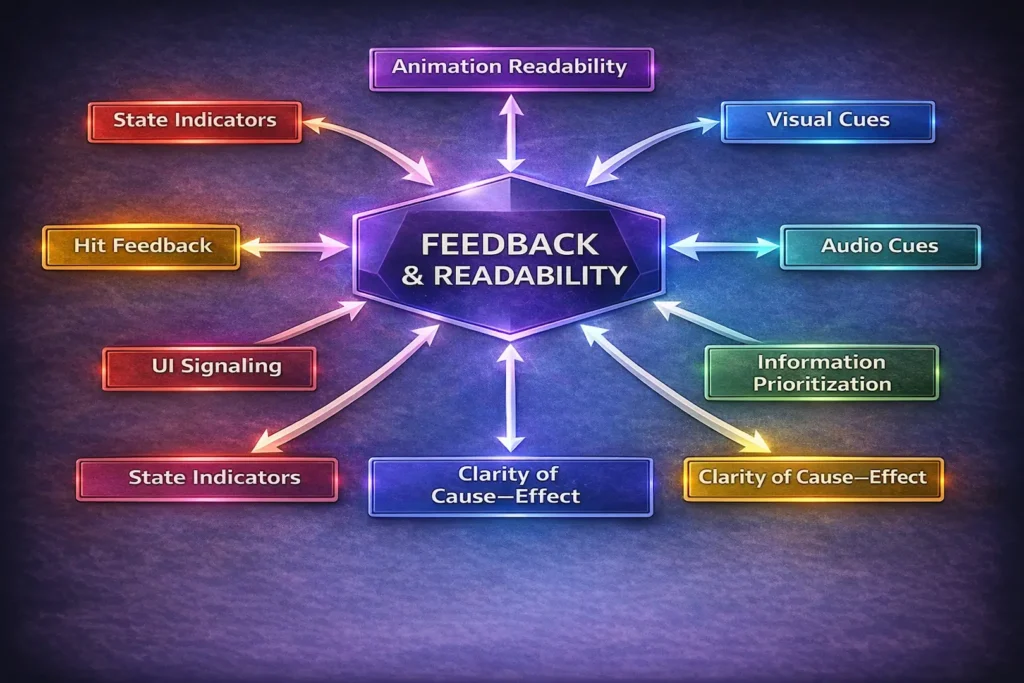
One of the most misunderstood pillars of game design is Feedback & Readability. This pillar concerns how clearly the game communicates with the player. We are not talking about aesthetics, but understanding—whether the player perceives what is happening, why it is happening, and what the result of their action was.
Feedback is the game’s reaction to the player’s actions. Readability is how easily that reaction becomes perceivable and interpretable. If the player cannot “read” the game, they do not play strategically. They guess, and proceed randomly.
What It Addresses
This pillar addresses the flow of information between game and player. It determines whether the player understands the state of their character, enemies, the environment, and the systems currently in motion.
This is where gameplay fairness and predictability are judged—not in the sense of being easy, but in the sense of being understandable. A game can be demanding as long as it remains readable.
What It Consists Of
Feedback & Readability is built from design components that define how and when information is delivered:
- animation readability (animation readability)
- visual cues (visual cues)
- audio cues and confirmations (audio cues)
- hit feedback (hit feedback)
- state indicators (state indicators)
- UI/HUD signaling (UI signaling)
- cause–effect clarity (cause–effect clarity)
- information hierarchy and prioritization (information prioritization)
All of these exist to serve understanding, not to impress.
Its Purpose
The purpose of Feedback & Readability is to ensure the player knows what they are doing and what is happening to them. That they can make decisions based on information, not on assumptions.
A game with strong feedback does not need to constantly explain its rules. It shows them. The player learns through the system’s reactions to their actions.
Its Impact on the Game
Feedback quality directly affects sense of control, challenge, and perceived fairness. When information is clear, the player accepts failure. When it’s vague, failure feels arbitrary.
Readability also defines how quickly the player can react and improve. An unreadable game cuts its learning curve before it even begins.
What It Does
The Feedback & Readability pillar:
- turns systems into an understandable experience
- supports player agency and challenge
- reduces confusion and cognitive load
- allows the player to play consciously
It is the translator between mechanical complexity and human perception.
What It Does Not Do
It does not replace system design and does not fix bad design decisions. Also, more feedback does not mean better feedback. Information overload can be as destructive as information absence.
Its role is not to say everything, but to say the right things at the right time.
When It’s Missing or Underperforming
When Feedback & Readability is weak, the game begins to feel unfair. The player doesn’t understand why they were hit, why they failed, or why they succeeded. The result is frustration and disengagement.
In these cases, the problem is not difficulty. It’s that the game does not speak clearly to the player.
Pillar 6 – Progression & Motivation
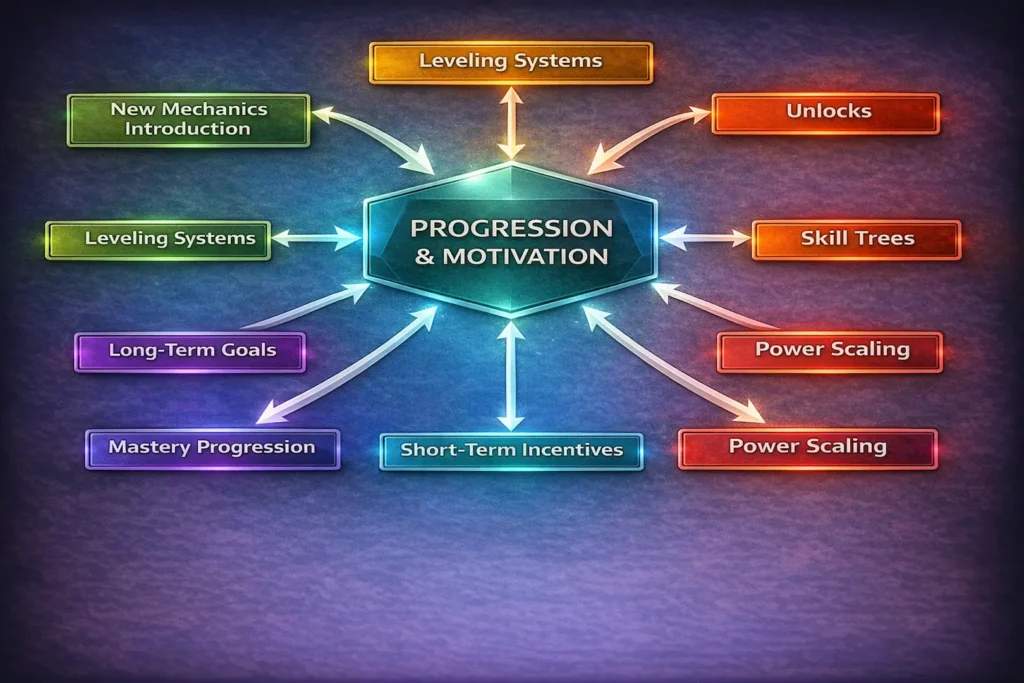
The Progression & Motivation pillar concerns how the player evolves within the game and why they choose to keep playing. We are not simply talking about numbers going up or content unlocks, but whether progression meaningfully changes how the game is played.
Progression is the evolution of capabilities, options, or understanding. Motivation is the reason that evolution matters to the player. One without the other leads either to mechanical repetition or empty grinding.
What It Addresses
This pillar addresses the relationship between time and reward. It determines whether the time the player invests returns as new capabilities, strategies, or experiences.
This is where we judge whether progression is merely quantitative or genuinely qualitative—whether the player simply becomes “stronger,” or becomes different in how they play.
What It Consists Of
Progression & Motivation is formed by design components that define how progression is unlocked and experienced:
- leveling systems (leveling systems)
- unlocks (unlocks)
- skill trees and choice structures (skill trees)
- power scaling (power scaling)
- gradual introduction of new mechanics (new mechanics introduction)
- long-term goals (long-term goals)
- short-term incentives and rewards (short-term incentives)
- mastery progression (mastery progression)
Progression gains value when it changes the player’s decisions, not just their stats.
Its Purpose
The purpose of Progression & Motivation is to sustain the player’s interest in a meaningful way. To create direction and evolution connected to gameplay, not to external artificial incentives.
Well-designed progression rewards learning, not just persistence. It gives the player new ways to engage with systems instead of repeating the exact same actions with larger numbers.
Its Impact on the Game
This pillar directly impacts the game’s longevity and player commitment. When progression is meaningful, the player returns because they want to see how their play evolves. When it’s superficial, they return out of habit or obligation.
Progression also acts as a bridge between the core gameplay loop and more complex systems, gradually opening depth over time.
What It Does
The Progression & Motivation pillar:
- provides a sense of journey and evolution
- increases player commitment
- differentiates gameplay over time
- rewards learning and mastery
It is why a game doesn’t burn out after the first hours.
What It Does Not Do
It does not replace a weak core gameplay loop and does not rescue shallow systems. More progression does not automatically mean a better experience. If progression doesn’t meaningfully change gameplay, it becomes grind without meaning.
Its role is not to keep the player “hooked,” but to give them a reason to continue.
When It’s Missing or Underperforming
When Progression & Motivation is problematic, the game feels stagnant. The player feels they are doing the same things without meaningful evolution, or that progression is disconnected from their choices.
In these cases, the problem is not a lack of content. It’s that progression lacks direction and impact.
Pillar 7 – Narrative & Context
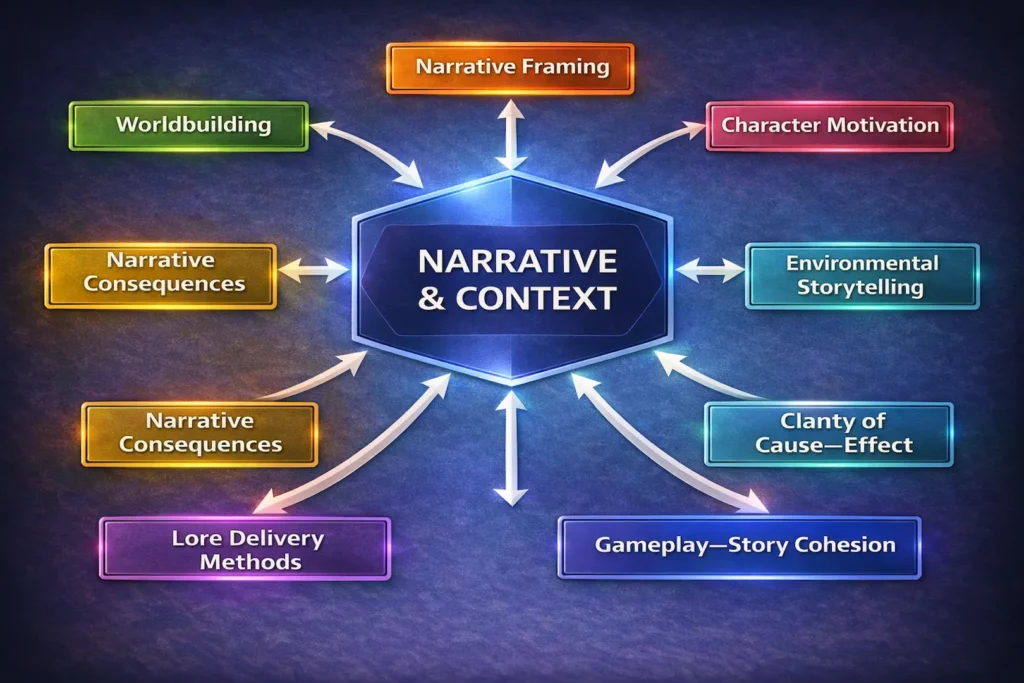
The Narrative & Context pillar concerns the framework within which the player’s actions gain meaning. It is not the same as script, dialogue, or cutscenes. It is about why the player does what they do, and how the game justifies actions, goals, and consequences.
Narrative is storytelling in the broad sense. Context is the functional framing that gives weight to actions. A game can have minimal story and still have strong narrative context.
What It Addresses
This pillar addresses the relationship between gameplay and meaning. It determines whether player actions are merely mechanical or embedded in a world with logic, identity, and consistency.
This is where we judge whether the player feels they are participating in something that evolves, or simply executing objectives without emotional or thematic weight. Narrative context acts as the glue that turns systems into experience.
What It Consists Of
Narrative & Context is formed by design components that define how and where meaning is delivered:
- worldbuilding coherence (worldbuilding)
- character and faction motivations (character motivation)
- environmental storytelling (environmental storytelling)
- narrative framing integrated into gameplay (narrative framing)
- narrative consequences of choices (narrative consequences)
- lore delivery methods (lore delivery methods)
- gameplay–story cohesion (gameplay–story cohesion)
Narrative works when it supports gameplay rather than trying to replace it.
Its Purpose
The purpose of Narrative & Context is to assign meaning to player actions. To make decisions, conflicts, and progression feel embedded in a world that reacts and evolves.
Strong narrative context doesn’t need complexity. It needs consistency and respect for what the game asks the player to do.
Its Impact on the Game
This pillar affects emotional connection and what the game leaves behind in memory. The player remembers not only what they did, but why they did it.
When narrative context is weak or disconnected, gameplay may remain functional, but rarely becomes memorable. When it is strong, even simple mechanics gain weight.
What It Does
The Narrative & Context pillar:
- justifies player actions
- strengthens world coherence
- supports emotional engagement
- turns gameplay into an experience with identity
It doesn’t lead the player. It gives them a reason to care.
What It Does Not Do
It does not fix weak systems and does not cover gameplay problems. It also does not require large volumes of text or cinematic delivery. A game can have strong narrative context without traditional story.
Its role is not to impress narratively, but to support actions.
When It’s Missing or Underperforming
When Narrative & Context is problematic, the game feels empty. The player completes objectives without connection or significance. Choices lose weight and progression feels mechanical.
In these cases, the problem is not that “there is no story.” It’s that there is no reason to care about what you do.
Pillar 8 – UX & Flow
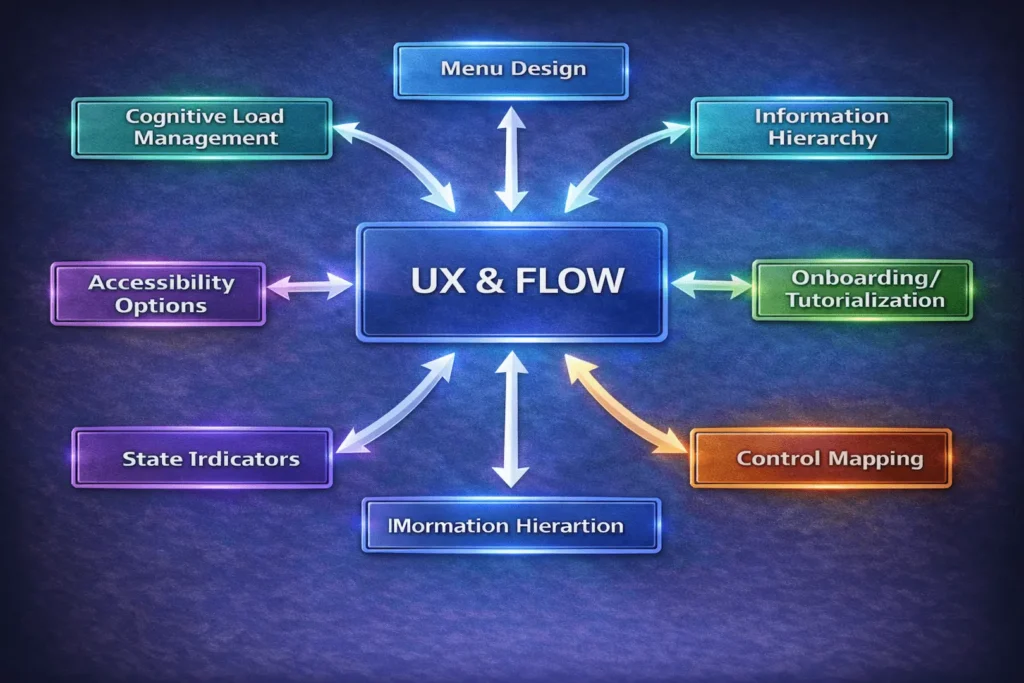
One of the most important and most “hidden” pillars of game design is UX & Flow, which concerns how smoothly and effortlessly a game is played. It is not about whether something looks “nice,” but whether it is understandable, functional, and free of unnecessary friction. It is the way the player interacts with the game at a practical level, from first contact to more complex situations.
UX is the overall user experience. Flow is the state where the player plays without thinking about the interface, the controls, or the processes. When the player is thinking about the UI, something is wrong.
What It Addresses
This pillar addresses the player’s cognitive and practical load. It determines how much effort is required to understand what to do, how to do it, and where to look.
This is where we judge whether the game helps the player play, or forces them to fight menus, information, and ambiguity. UX & Flow doesn’t make a game easier. It makes it clearer.
What It Consists Of
UX & Flow is formed by design components that define usability and experience pacing:
- menu design and logic (menu design)
- information hierarchy and presentation (information hierarchy)
- onboarding and tutorialization (onboarding / tutorialization)
- control mapping and customization (control mapping)
- friction points and delays (friction points)
- accessibility options (accessibility options)
- cognitive load management (cognitive load management)
All of these exist to serve flow, not disrupt it.
Its Purpose
The purpose of UX & Flow is to allow the player to focus on gameplay and decisions, not on how the game works. To remove obstacles that add no meaning and leave room for engagement and learning.
A game with good UX does not draw attention to itself. It disappears and works quietly in the background.
Its Impact on the Game
UX quality affects first impression, learning curve, and player endurance. Even excellent systems can fail if the player cannot understand or comfortably operate them.
Flow, when achieved, creates continuity and control. When broken, the experience fragments.
What It Does
The UX & Flow pillar:
- reduces unnecessary complexity
- improves understanding and handling
- supports learning without overload
- helps the player enter a rhythm
It is the invisible mechanism that keeps the experience moving.
What It Does Not Do
It does not fix bad gameplay and does not replace system design. Also, simplification does not mean removal of depth. Clean UX can support complex systems if designed properly.
Its role is not to “hold the player’s hand” during gameplay, but to avoid putting barriers in their way without reason.
When It’s Missing or Underperforming
When UX & Flow is problematic, the game becomes tiring quickly. The player wastes time in menus, gets confused by information, and becomes distracted from gameplay itself.
In these cases, the problem is not that the game is difficult. It’s that it is dysfunctional.
Pillar 9 – Technical Foundation
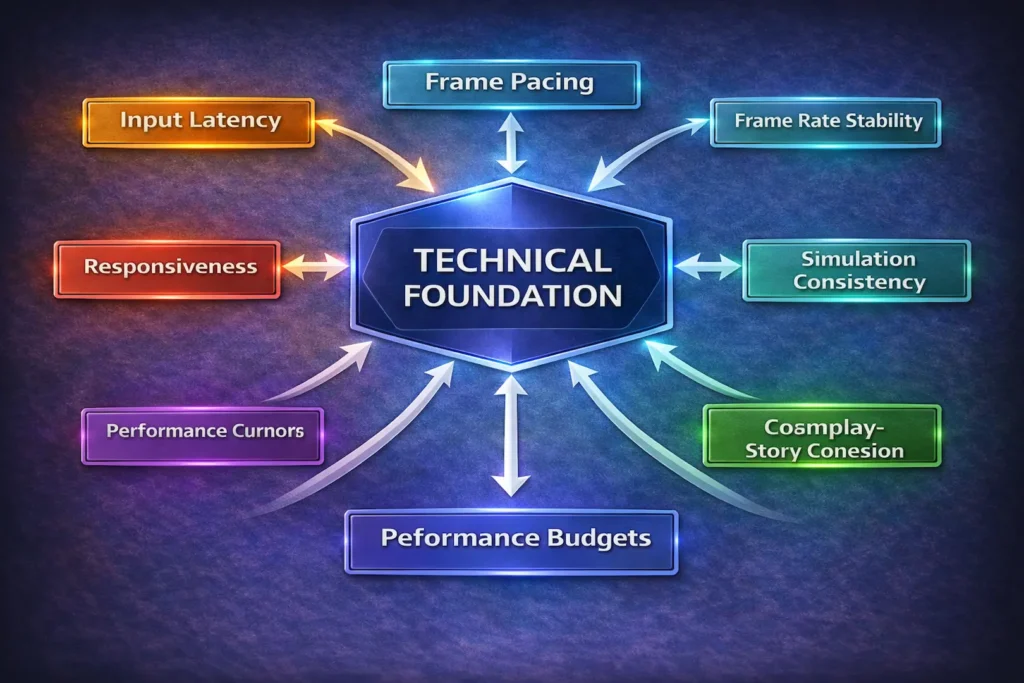
The Technical Foundation pillar concerns the technical base on which all other pillars of game design rely. It is not a “technical topic” in the narrow sense of engine or hardware. It is about whether the game responds correctly, consistently, and predictably to the player’s actions.
If the technical foundation is weak, the best design in the world never reaches the player as intended.
What It Addresses
This pillar addresses the relationship between intent and execution. It determines whether what the player wants to do is implemented consistently, without delays, discontinuities, or unpredictable behavior.
This is where the “feel” of the game is judged—not whether it simply runs, but whether it feels right to play.
What It Consists Of
Technical Foundation is formed by design components that directly affect control feel and reliability:
- input latency (input latency)
- frame pacing consistency (frame pacing)
- frame rate stability (frame rate stability)
- simulation consistency (simulation consistency)
- responsiveness (responsiveness)
- performance budgets and limits (performance budgets)
- platform optimization (platform optimization)
These elements are not always visible, but they become immediately noticeable when something goes wrong.
Its Purpose
The purpose of Technical Foundation is to ensure the game behaves consistently. That mechanics, feedback, and control function the way the other pillars promise they will.
A solid technical foundation doesn’t draw attention. It simply allows design to express itself without distortion.
Its Impact on the Game
Technical Foundation quality directly affects player agency, challenge, and feedback. Delays, frame drops, or inconsistencies distort the experience and turn correct decisions into failures.
When the technical base is stable, the player trusts the game. When it isn’t, trust is lost quickly and is hard to regain.
What It Does
The Technical Foundation pillar:
- ensures reliable control
- supports gameplay accuracy
- enables fair challenge
- protects design intent
It is the foundation that holds everything else upright.
What It Does Not Do
It does not fix bad design decisions and does not substitute for game design. A technically flawless game can still be boring. Its role is supportive, not creative.
Also, high performance doesn’t automatically mean good feel if consistency and responsiveness are not properly tuned.
When It’s Missing or Underperforming
When Technical Foundation is weak, the game begins to “break” on every level. The player loses control, feedback is distorted, and challenge becomes unfair for no obvious reason. Systems stop functioning, and the player feels like they are playing a broken game without being able to clearly explain why.
In these cases, the problem is not that the game is demanding. It’s that it is unreliable.
The Pillars of Game Design as a System, Not a List

The pillars of game design do not operate in isolation. They are not checkboxes, nor independent chapters you can add or remove at will. They function as a system of balance. When one pillar underperforms, pressure shifts to the others. And sooner or later, something breaks.
A game can have excellent systems, but if feedback is not readable, the player will not use them. It can have strong narrative context, but if the core gameplay loop is weak, the experience will exhaust the player. It can have perfect technical execution, but if there is no player agency, the result will feel empty. No pillar “saves” the others. It supports them.
That is why game design cannot be treated fragmentarily. It is not a collection of good ideas, nor an accumulation of features. It is architecture. And as with any architecture, foundations, beams, and connections matter more than decoration. In the same logic, all pillars of game design support one another.
The nine game design pillars analyzed here are neither a theoretical construction nor an arbitrary model. They are the convergence of decades of practice, analysis, and industry experience. They appear under different names in different frameworks, but the problems they solve are always the same. And when they are ignored, the symptoms repeat with mathematical precision.
From here on, analysis cannot remain only on the pillars of game design. Each pillar is made of individual design components—specific problems and decisions that have direct impact on gameplay. In upcoming articles, each pillar will be broken down into its parts. Each component will be analyzed separately, with technical accuracy and practical examples, to make it clear how it affects the player experience and how it connects to the whole.
Because good game design isn’t visible when everything goes right. It becomes visible when you know exactly why things work—or why they don’t.