
Framing the Problem
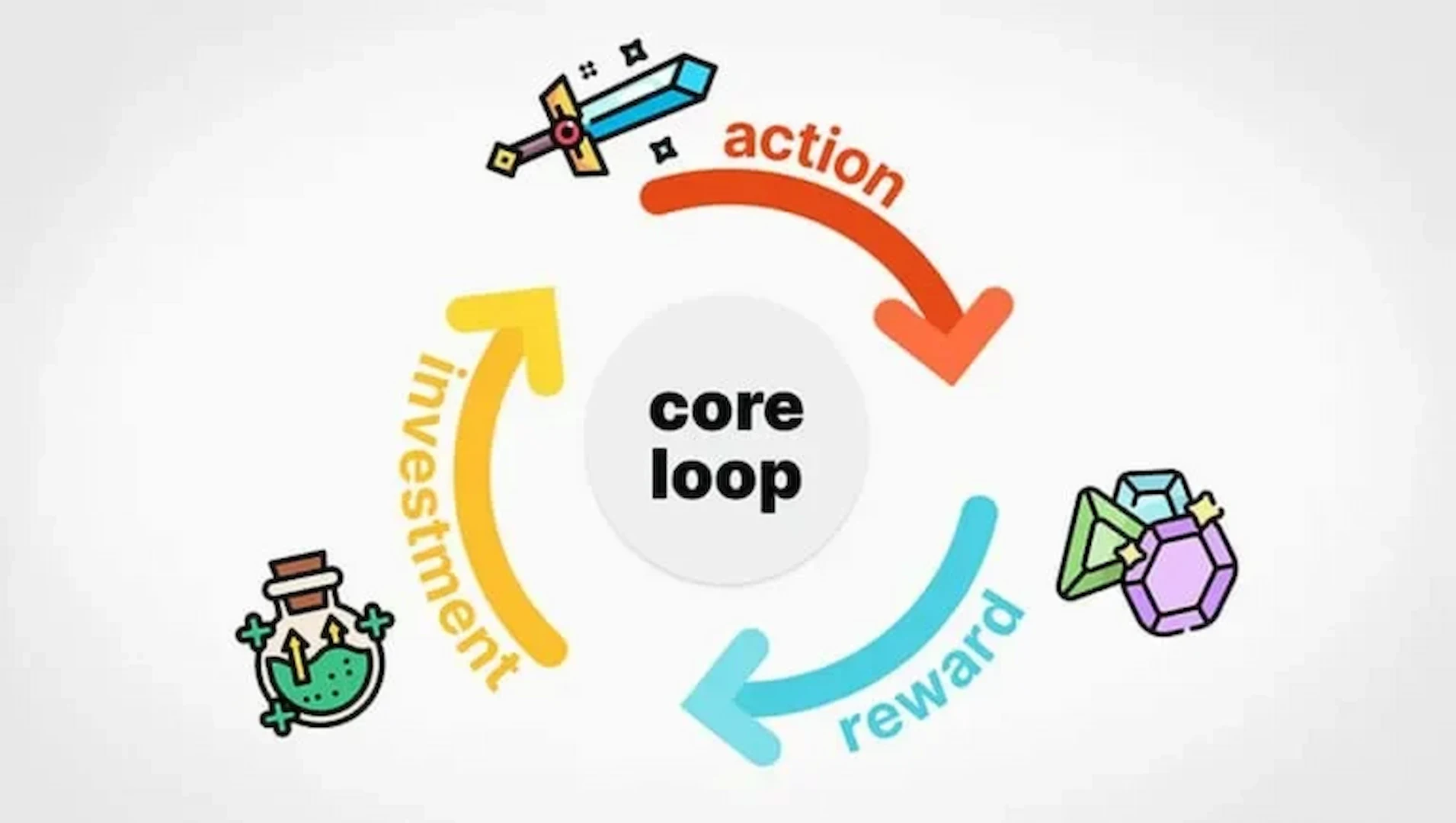
This article builds on the broader framework introduced in our foundational analysis of the nine core pillars of game design. Within that framework, the Core Gameplay Loop defines how player actions, system responses, and outcomes connect over time. The reward cycle is examined here as a critical internal mechanism of that pillar, responsible for reinforcing learning, shaping expectations, and stabilizing moment-to-moment decision-making.
In many projects, the reward cycle is treated as a content delivery problem rather than a systemic one. Rewards are added to maintain engagement, smooth retention curves, or justify progression pacing. This framing is convenient, but it is also misleading. A reward cycle is not primarily about what the player receives. It is about what the system communicates.
At a systemic level, the reward cycle defines how player actions are evaluated, how outcomes are interpreted, and how future decisions are shaped. When this communication is unclear, inconsistent, or overly generous, the core gameplay loop begins to erode. The game may continue functioning mechanically, but the player’s decision-making collapses into habit or exploitation.
This is why reward cycles should be analyzed as part of the core gameplay loop, not as a downstream layer of progression or monetization. They are one of the main instruments through which the game teaches the player how it expects to be played.
The Reward Cycle in Game Design, Beyond Items and Numbers
A common misconception is that rewards are synonymous with tangible outputs such as items, currency, experience points, or unlocks. These are delivery mechanisms, not rewards in the design sense. The actual reward is the informational signal attached to the outcome of an action.
When a player performs an action, the system responds. That response communicates success or failure, efficiency or waste, alignment or misalignment with intended play. The player then updates their internal model of how the game works. If the signal is strong and readable, the player learns. If it is noisy or contradictory, the player compensates by trial-and-error, optimization, or disengagement.
A reward that does not alter the player’s understanding or expectations is functionally inert. It may feel pleasant in isolation, but it does not reinforce the loop. In practice, this leads to games that appear generous while quietly training players to stop caring about outcomes.
Reward Cycle as a Learning Loop
At its core, the reward cycle in game design, operates as a learning loop embedded within moment-to-moment play. The sequence is not action followed by reward, but action followed by outcome, interpretation, and expectation. Each iteration refines the player’s mental model of the system.
The quality of a reward cycle depends on how reliably the system links cause and effect. When the player can infer why an outcome occurred, trust in the system increases. When outcomes feel arbitrary or overly abstracted, trust degrades. Once trust is lost, players stop engaging with the system as designed and begin searching for dominant strategies or shortcuts.
Importantly, predictability and clarity are not the same thing. A readable reward cycle does not have to be immediately predictable. It has to be interpretable. Games that mistake surprise for engagement often overload the reward layer, masking systemic flaws with variability instead of addressing feedback quality.
Where Reward Cycles Break in Production
Reward cycles rarely fail because of a single bad decision. They fail through accumulation. Early over-rewarding is a common issue, especially in onboarding phases where designers attempt to protect players from frustration. When early actions are rewarded regardless of quality or intent, the system teaches that precision and understanding are optional. Later attempts to introduce mastery-based rewards then feel punitive rather than motivating.
Another frequent failure occurs when rewards invalidate challenge. If rewards compensate too aggressively for mistakes, difficulty loses meaning. The player no longer needs to engage with the system’s depth because recovery is guaranteed. This is often justified as accessibility, but in practice it undermines learning and agency.
A more subtle issue arises when rewards are decoupled from explanation. Systems may deliver consistent outputs while failing to explain why those outputs occurred. In such cases, players receive feedback without context. They learn that something happened, but not what they did to cause it. Over time, this erodes the perceived coherence of the game’s rules.
Reward Cycle Versus Progression Systems
Reward cycles are frequently conflated with progression systems, especially in production environments where both are implemented through similar content pipelines. This conflation leads to structural design errors.
Progression systems operate on a long-term horizon. They define growth, escalation, and access over time. Reward cycles operate on a short-term horizon. They validate decisions in the moment and shape immediate behavior. When progression is used as a substitute for rewards, moment-to-moment play loses clarity. When rewards are overloaded to carry progression goals, pacing collapses.
A healthy design treats progression as context and reward cycles as feedback. The former answers where the player is going. The latter answers whether the player is playing well according to the system’s rules. Confusing these roles results in games that feel busy but directionless.
Identifying What to Fix First
In game design, when a reward cycle is underperforming, the solution is rarely to add more rewards. The first step is to audit signal clarity. Designers should identify which player actions the system is attempting to reinforce and examine whether the feedback makes that reinforcement legible.
Often, the most effective intervention is removal rather than addition. Cutting redundant rewards can restore meaning to those that remain. In other cases, delaying a reward can strengthen its interpretive value by allowing the player to connect it more clearly to prior actions.
Crucially, there are moments where the correct design choice is to withhold a reward entirely. Not every action deserves validation. Strategic absence can be as instructive as explicit feedback, especially when the system needs to communicate inefficiency or misalignment.
Closing Perspective
Reward cycles are not motivational tools layered on top of a game. They are structural components of the core gameplay loop. They define how the game communicates, teaches, and builds trust with the player. When treated superficially, they inflate engagement metrics while hollowing out agency. When treated systemically, they become one of the strongest instruments for sustaining meaningful play.
Designing reward cycles at this level requires restraint, clarity, and a willingness to let the system speak for itself. The goal is not to constantly reward the player, but to consistently tell the truth about their decisions.