

Within the Player Agency & Control pillar, what ultimately matters is not whether “choices exist,” but whether you feel that your choices are real, understandable, executable, and lead to consequences the game does not quietly undo behind the scenes.
The Freedom vs Constraints component defines exactly this relationship in game design.
The balance between these two determines how much room a game gives you to act, and how much it “holds you back” in order to protect pacing, readability, difficulty, production constraints, and technical stability. If the Core Gameplay Loop defines what you do over and over, here we are talking about how, when, how much, and under what conditions you are allowed to do it.
And to be clear, this component is not philosophy. It is a concrete set of rules: access rules, gating, affordances, fail states, economy systems, spatial and temporal rules, camera control, input buffering, aim assist, traversal constraints, friction, cooldowns, permissions, AI leashes, navmesh limitations, quest locks, interaction priority, and dozens of other points that, in practice, author agency.
In the central article outlining the 9 core pillars of game design, this pillar functions as the bridge between design intent and what the runtime actually allows. Freedom vs Constraints sits here as the mechanism that keeps the design promise coherent.
If the central piece is the map, this is the set of physical laws that decide what is possible and what is not.
What We Actually Mean by “Freedom” and “Constraints” in Game Design

Freedom, in technical terms, does not mean “absence of rules.” It is the range of viable actions you can perform, with predictable feedback, without colliding with invisible limitations that invalidate your intent. It is the available choice space within a ruleset.
Constraints, conversely, are not the “removal of freedom.” They are the mechanisms that shape this space so it remains readable, evaluable, balanced, producible, and technically stable. In essence, constraints are the governance of freedom, not its negation.
The critical point many designers miss is that the experience of agency does not come from the number of options, but from the ratio of perceived freedom to perceived cost.
If you see options but cannot understand their cost, tradeoffs, or consequences, freedom becomes noise.
If you understand cost but the game blocks you in irrelevant places, constraints feel arbitrary.
Freedom vs Constraints is therefore a balance between action space and the systems that give meaning to that space.
The Illusion of Freedom — and Why It Isn’t Always Bad
Here is an uncomfortable truth: you often do not need massive actual freedom to feel agency. You need freedom where your mind expects it, when you ask for it, in a way that aligns with your intent.
This means that the illusion of freedom can be a perfectly legitimate design tool — as long as it does not turn into deception.
The difference between a good illusion and bad deception is consistency. If the game presents choices that always converge to the same outcome, this can work for narrative pacing, thematic cohesion, or onboarding. It becomes a problem when you invest cognitively and emotionally in decision-making and the system “punishes” you for trusting what it presented as a choice.
In simple terms: illusion is a pacing tool. Deception is a contract breach.
Technically, this is where decision irrelevance detection comes into play. Players quickly learn whether their decisions matter, because consequence feedback loops are detectable. When deviations are consistently forced back, players shift into meta-play — optimizing for the system rather than role or intent.
That is agency collapse, and it is one of the most insidious failures of this component.
The Intent Contract: Why Constraints Must Explain “Why,” Not Just “No”

For a constraint to be accepted, it must be justified in a way the player recognizes as reasonable. That justification can be:
- Diegetic, emerging from world or narrative
- Systemic, emerging from gameplay rules
- Interface-based, emerging from clear signaling
What it cannot be — without cost — is silent.
A silent constraint says “you can’t” without telling you whether you are weak, whether the world has rules, whether a quest is locked, or whether it simply was not implemented.
Silent constraints prevent the construction of a valid mental model. Without a mental model, there is no real agency — only trial-and-error. Trial-and-error is not inherently bad, but it must be intentional. It fits stealth sandboxes. It breaks tactical clarity.
Categories of Constraints and Their Role in Agency
Constraints are not a single thing. They are families of mechanisms, each with different agency risks.
Spatial Constraints
Define where you can go: walls, locked doors, invisible barriers, traversal limits, stamina gating, climb rules, navmesh boundaries, collision volumes.
The risk is that the world feels fake or forcibly restrictive. The solution is rarely “remove obstacles” — it is make obstacles legible and logical and preserve intent through alternative paths.
Temporal Constraints
Define when actions are allowed: cooldowns, day-night locks, time windows, turn economy, tempo systems, animation locks, i-frames, reaction windows.
The risk is ignored input or punishment for intent expressed “too early.” Here, technical quality matters. Input buffering, cancel windows, animation blending, and readable telegraphs make constraints feel fair.
Resource Constraints
Define how much you can do: ammo, mana, stamina, durability, inventory limits, carry weight, crafting inputs, currency sinks.
The risk is turning agency into accounting or grind tax. When tuned correctly, these constraints create meaningful tradeoffs — some of the strongest agency tools available.
Systemic Constraints
Define what counts as a valid action: aggro rules, stealth visibility models, line-of-sight, hit confirmation, physics limits, interaction priority, AI state machines, detection thresholds.
The risk is perceived unfairness when the system contradicts what you see. Readability is king here.
Narrative / Structural Constraints
Quest gating, story locks, mandatory sequences, reconverging branches, soft locks for pacing protection.
The risk is agency theatre. The correct use aligns constraints with theme and avoids presenting non-choices as choices.
Production / Technical Constraints
Streaming budgets, memory limits, animation coverage, quest state explosion, save/load complexity, network determinism, simulation cost, tooling limits.
These are real — but if they surface directly to the player, agency breaks because the world reveals itself as a construction site.
Hard Gating vs Soft Gating — and Why Soft Gating Is Harder Than It Sounds
Hard gating blocks you explicitly. You cannot pass. It is clear, but risky.
Soft gating discourages rather than forbids — via difficulty, information, economy, danger, enemy strength, environmental cues, pacing incentives, scarcity.
Good soft gating lets you make a “bad” decision and experience it.
Bad soft gating is either a hard gate in disguise or so weak it fails to guide pacing at all.
Technically, soft gating demands tuning and telemetry. Without data, designers rely on intuition — great for prototypes, useless at scale.
Constraints as Gameplay Language: How Limitation Teaches
Mature design shows when constraints teach rather than block.
A constraint that forces you to adapt teaches you how the game thinks.
Cooldowns teach rhythm.
Preparation gates teach scouting and risk assessment.
Scarcity teaches efficiency and positioning.
In all cases, the constraint shapes the decision space. It does not remove agency — it gives it form.
Friction — and Why “A Little” Is Often More Dangerous Than “A Lot”
Friction is any cost between intent and execution: animation locks, slow UI, input delay, looting time, confirmation steps, travel time, fast-travel limits.
Low friction often feels good — until it strips decisions of weight. Excessively smooth systems lose tension and meaning.
The right question is not “how much friction,” but where friction creates meaning.
Survival and tactical systems rely on it. Dexterity-driven systems must control it carefully.
Misplaced friction kills control. Purposeful friction creates depth.
When Freedom Collapses: State Explosion and System Instability
More freedom means larger state space. Every added option multiplies interactions, edge cases, QA load.
When complexity becomes unsustainable, constraints appear — often in ways that feel arbitrary.
Players will not forgive constraints that retract previously granted freedom.
Mature design does not give freedom everywhere. It selects expressive channels and closes others consistently.
Combat creativity vs narrative rigidity. Narrative branching vs systemic exploits.
Everything open usually means nothing is reliable.
Freedom Without Readability Is Not Agency — It’s Confusion
Agency requires approximate prediction. Not outcomes — risk type, cost type, direction.
Open worlds without signaling produce wandering, not decision-making. Even exploration-driven games require meaning boundaries.
Landmarks, threat levels, motifs, audio cues, systemic hints, and informative quest logs turn freedom into usable space.
The Ethics of Constraints: Fair vs Manipulative Limitation
There is a difference between “this is the game” and “we had no other way.”
Fair constraints are consistent, readable, learnable, and applied evenly.
Manipulative constraints violate their own rules: scripted misses, teleporting AI, conditional locks, hidden difficulty shifts.
These collapse agency because they reveal the world as performance, not system.
Constraints as Pacing Tools Without Stealing Control
Pacing is the rhythm of decisions.
High tempo demands clarity and recovery.
Low tempo demands weight and tension.
Solving pacing with brute locks trains players not to experiment. Incentives, cost shaping, and information are cleaner tools.
Freedom vs Constraints Across Experience Types
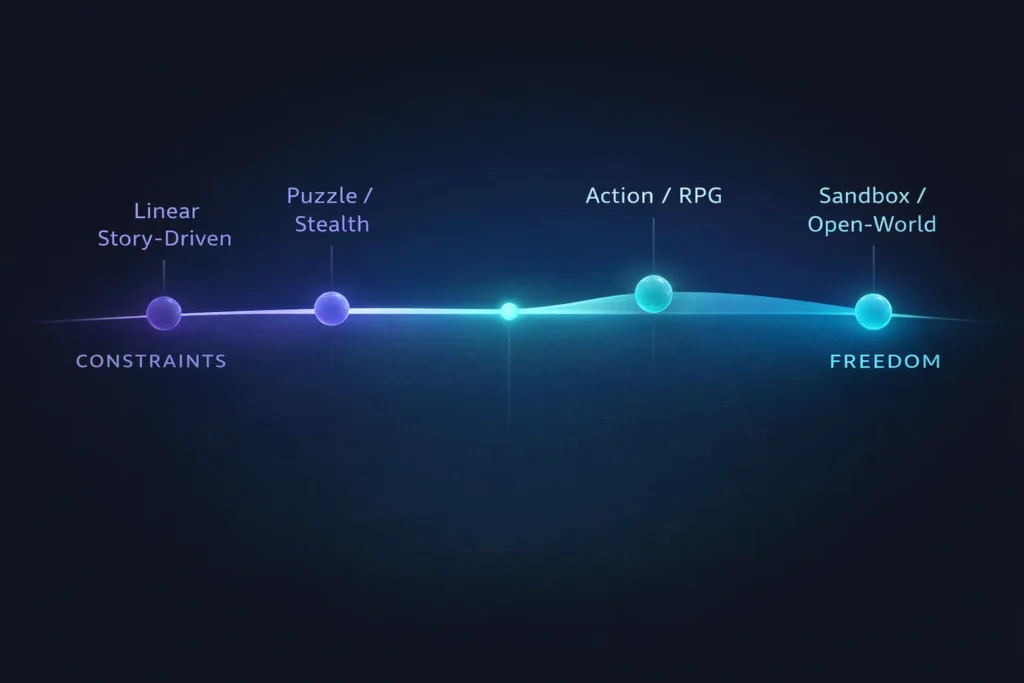
Immersive sims favor systemic consistency and minimal hard gates.
Narrative experiences favor pacing but must avoid selling false agency.
Competitive games prioritize fairness and readability.
Strategy and management derive freedom from choices within constraints.
In all cases, constraints must feel like part of the game — not its limitation.
The Technical Layer of Control: Input, Camera, and Tactile Cost
Agency collapses if tactile control fails.
Animation locks need buffers and cancels.
Camera constraints must preserve information.
Aim assist must match fantasy and skill targets.
A constraint without reliable feedback feels like a bug. And players do not negotiate with bugs.
Exploits, Sequence Breaks, and the Design Dilemma
More freedom invites exploits. The answer is classification.
Some exploits enhance fun.
Some destroy progression.
Some break fairness.
Mature design knows what it protects — and for whom.
Measurement and Validation: How You Know the Balance Works
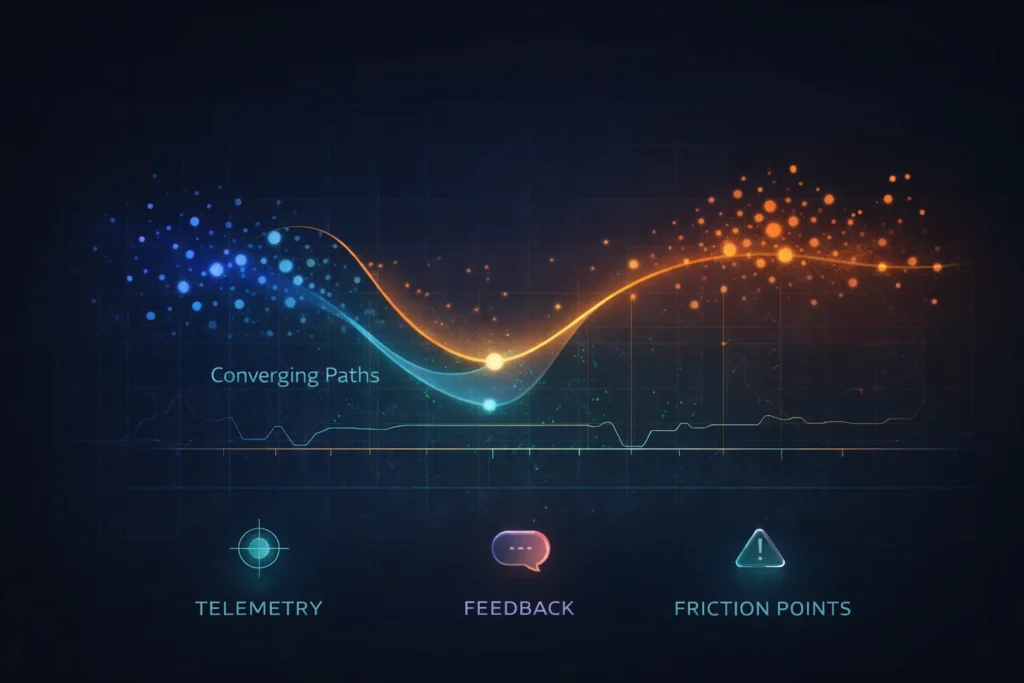
Qualitatively: do players describe failure as fair? Do they plan and adapt?
Quantitatively: abandonment at gates, comprehension time, tool usage, path variance, death heatmaps, strategy convergence.
Uniform play indicates false freedom or over-restrictive constraints. Healthy agency shows diversity within structure.
Synthesis: A Design Discipline, Not an Ideology
Freedom vs Constraints is not about open vs linear games. Freedom vs Constraints it is discipline in game design.
Freedom without constraints creates instability.
Constraints without freedom create brittle corridors.
The goal is to justify every constraint as meaning-creating — not convenience — and every freedom as system-supported — not decoration.
Achieve that, and Player Agency & Control becomes tangible.
Position of Freedom vs Constraints Within the 9 Pillars of Game Design
Within the full framework of the 9 core game design pillars, Freedom vs Constraints acts as the mechanism that translates design intent into executable experience.
It is where theoretical agency is tested against rules, systems, UI, technical limits, and production realities. Without it, Player Agency remains abstract. With it, agency gains form, boundaries, and consistency — allowing all pillars to function as a coherent system rather than isolated principles.