
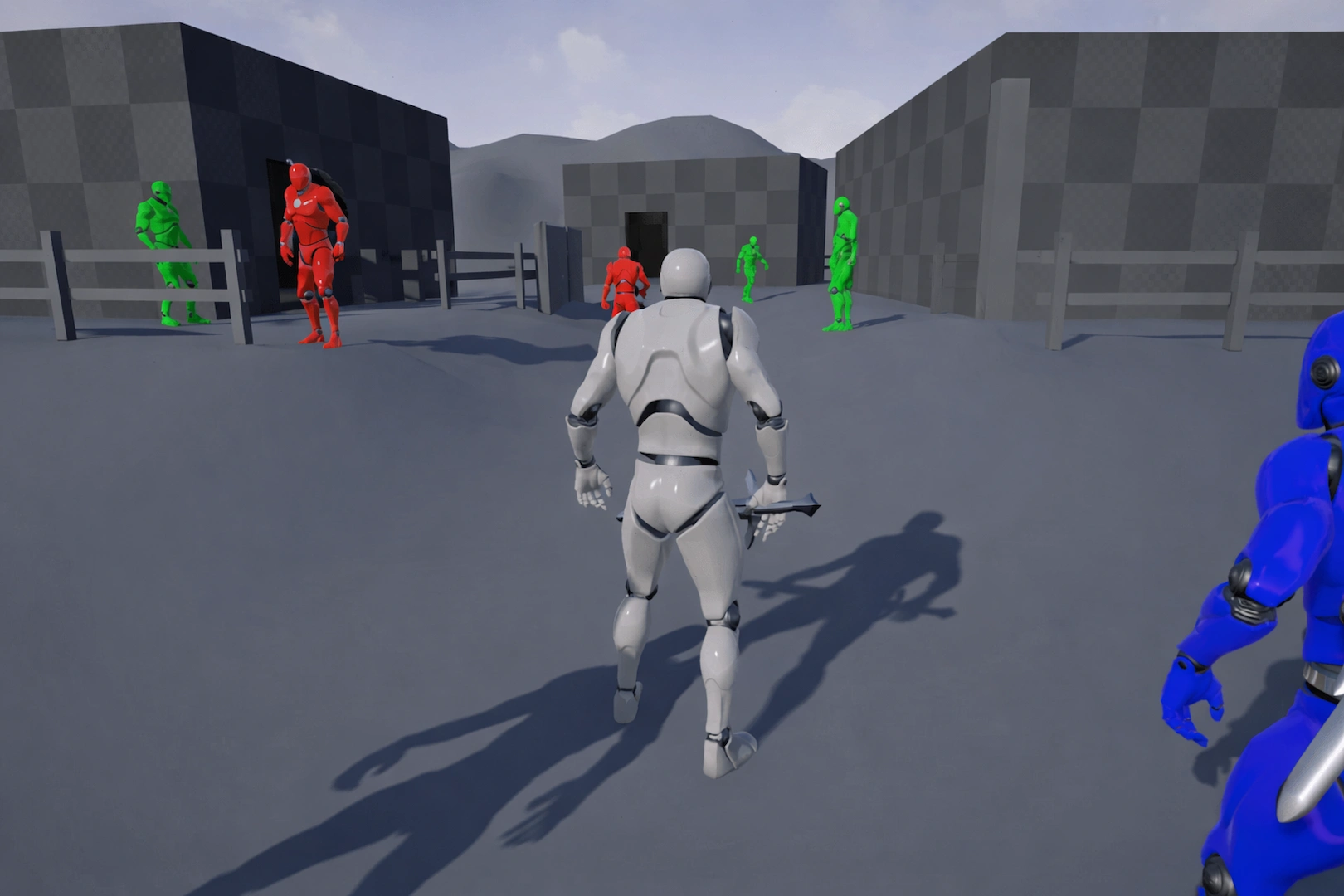
In most discussions around game design, AI is almost always described in terms of spectacle. “Smart,” “realistic,” “adaptive,” “human-like.” These terms sound impressive, but they rarely mean anything concrete at the design level. In practice, the AI Behavior System in game design, is neither a marker of technological superiority nor proof of design complexity. It is a fundamentally functional system that defines how the game responds to the player—and how the player learns to read the game.
Within the Systems & Mechanics pillar, AI does not operate autonomously. It is not an “extra layer” meant to impress. It is directly tied to the combat system, influences the economy system, and shapes pacing, pressure, and the overall credibility of the experience. When AI fails, other systems do not collapse technically—but they lose their believability. And that is often worse.
The most persistent misunderstanding is the idea that good AI exists to defeat the player, constantly surprise them, or prove that it “thinks.” Its real role is to behave in ways the player can understand, anticipate, and ultimately learn. When AI behavior is unreadable, difficulty feels unfair, combat feels random, and the game’s decisions feel arbitrary.
This article approaches the AI Behavior System as a design component within the broader framework of game design. Not as a technical implementation. Not as algorithmic showcase. We examine what it is, how it functions, where it fails, and why it remains one of the most underestimated yet decisive mechanisms of coherence in modern games.
What the AI Behavior System Is Not

To understand what the AI Behavior System is, we must first clarify what it is not. This is not academic pedantry. Confusion around AI starts precisely here. Most public-facing terms do not describe design—they describe impressions.
The AI Behavior System is not “smart AI.” Intelligence implies understanding, intent, and judgment. Game AI understands nothing. It executes rules. When its behavior appears intelligent, that effect comes from well-designed constraints, not from cognition. The clearer those constraints are, the more convincing the behavior becomes.
It is also not “realistic AI.” Unfiltered realism is often the enemy of gameplay. An AI that reacts like a real human—without hesitation, without mistakes, without telegraphed intent—produces an unfair and unreadable experience. The goal is not to simulate reality, but to create behavior that serves the core gameplay loop and pacing.
Nor is it “adaptive AI” in the way the term is commonly used. AI does not adapt because it “learns” the player. It adapts because the design allows certain parameters, priorities, or intensities to shift within predefined bounds. When that adaptation is invisible or arbitrary, it does not add depth—it undermines trust.
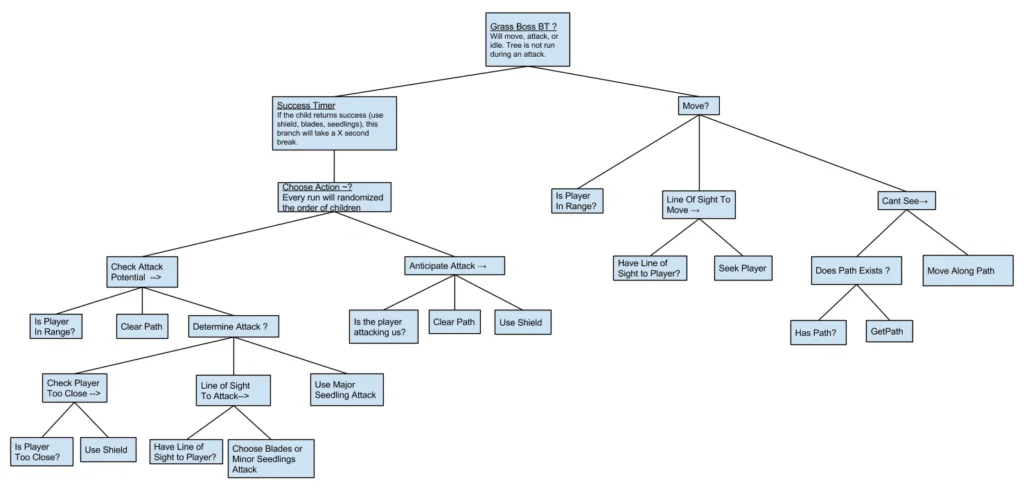
Finally, the AI Behavior System is not a showcase of technical superiority in game design. Complex behavior trees, advanced pathfinding, or sophisticated algorithms do not guarantee better gameplay. If the player cannot understand why the AI behaves the way it does, that complexity never translates into experience. It becomes noise.
The correct way to approach AI is as a tool for designed behavior. Not as an opponent trying to prove something. Not as a technical trick. Once these myths are stripped away, we can speak clearly about what the AI Behavior System actually is—and what role it truly plays within Systems & Mechanics.
What the AI Behavior System Is in Practice
Once misconceptions are removed, the AI Behavior System can be described for what it actually is: a functional design system. At the design level, AI is not intelligence—it is structured behavior activated under specific conditions.
At its core, an AI Behavior System in game design, consists of four elements: rules, priorities, reactions, and constraints. Rules define what the AI is allowed to do. Priorities determine what matters at any given moment. Reactions describe how behavior changes as the situation evolves. Constraints define what the AI cannot do—even if doing so would be optimal.
That last element is critical. AI without clear constraints does not feel powerful—it feels unfair. Good AI does not always choose the best possible action. It chooses the action the design allows it to choose. This is where readability emerges, and where player trust is built.
AI does not operate in isolation. It does not “think” independently of other systems. It reacts to information provided by the game: player position, available resources, time pressure, combat state, progression level. In this sense, the AI Behavior System is a state translator in game design. It takes game state data and converts it into behavior.
This is where its connection to the Systems & Mechanics pillar becomes evident. AI does not add new gameplay—it activates existing systems. In combat, it determines when the player is pressured and when they are allowed to breathe. In the economy, it indirectly shapes resource flow through threat and opportunity. When these systems are well-designed but poorly leveraged by AI, the experience collapses perceptually rather than mechanically.
The AI Behavior System is therefore not a background process. It is an active regulator of experience. The clearer its definition, the more stable and coherent player interaction becomes. That consistency is the foundation upon which more complex systems can safely exist.
Player Readability and Behavioral Transparency

No matter how well-designed an AI Behavior System may be, it fails the moment the player cannot read it. Behavioral readability is not polish or aesthetic refinement—it is a prerequisite for learning, progression, and perceived fairness.
AI does not need to constantly surprise the player. It needs to communicate intent. Every movement, pause, stance change, or behavioral pattern conveys information. When those signals are consistent, the player begins to anticipate. And once anticipation is possible, meaningful decisions emerge. That is where real gameplay exists.
A common misconception is that readability makes AI “easy.” In reality, the opposite is true. Readable AI can be far more demanding because responsibility shifts to the player. Failure has an identifiable cause. Success is not accidental. Challenge becomes deliberate rather than chaotic.
In this context, AI mistakes are not weaknesses—they are tools. Deliberate delays, overcommitment to actions, or moments where the AI selects a suboptimal option create windows of opportunity. Without them, behavior feels mechanical and inhuman. With them, it gains rhythm and character.
When behavioral transparency is absent, the result is predictable. Players stop learning and start reacting blindly. They play defensively, avoid risk, and rely on safe, repetitive strategies. Combat loses expressive depth and becomes an exercise in survival rather than decision-making.
Behavioral transparency does not mean simplification. It means consistency. And consistency is what allows AI to function not as an obstacle, but as a conversational partner within the gameplay space.
AI as a Regulator of Pressure, Pacing, and Difficulty
Beyond direct interaction, the AI Behavior System fulfills a less visible but critically important role in game design. It regulates pressure and pacing, shaping the difficulty curve without explicitly signaling its presence. Much of what players perceive as difficulty does not come from numbers, but from behavior.
AI determines when the player is under constant threat and when they are given space to recover. Through attack frequency, aggression, pauses, and state transitions, it defines experiential rhythm. Continuous pressure leads to exhaustion. Excessive leniency collapses tension and devalues progression.
At this level, AI functions as an invisible difficulty slider. It does not merely scale enemy strength—it shapes how threat is expressed. Two games can share similar statistics yet feel completely different due to how AI applies pressure.
The connection to the economy system is direct. Increased pressure raises the value of resources. Reduced pressure creates opportunity. When AI fails to regulate this relationship, economies either inflate or starve, regardless of underlying design.
The same applies to pacing. AI defines peaks and valleys in intensity. These fluctuations sustain attention and emotional engagement. A game without them feels flat, even if it functions mechanically.
Consistency is the key. When AI shifts rhythm or intensity without discernible cause, the experience feels arbitrary. Players cannot adapt because they cannot identify the trigger. Difficulty stops being a challenge and becomes an obstruction.
A well-designed AI Behavior System does not merely adjust difficulty. It defines when, how, and why pressure exists. That “why” keeps players active rather than defensive.
Emergent Behavior vs. Scripted Behavior
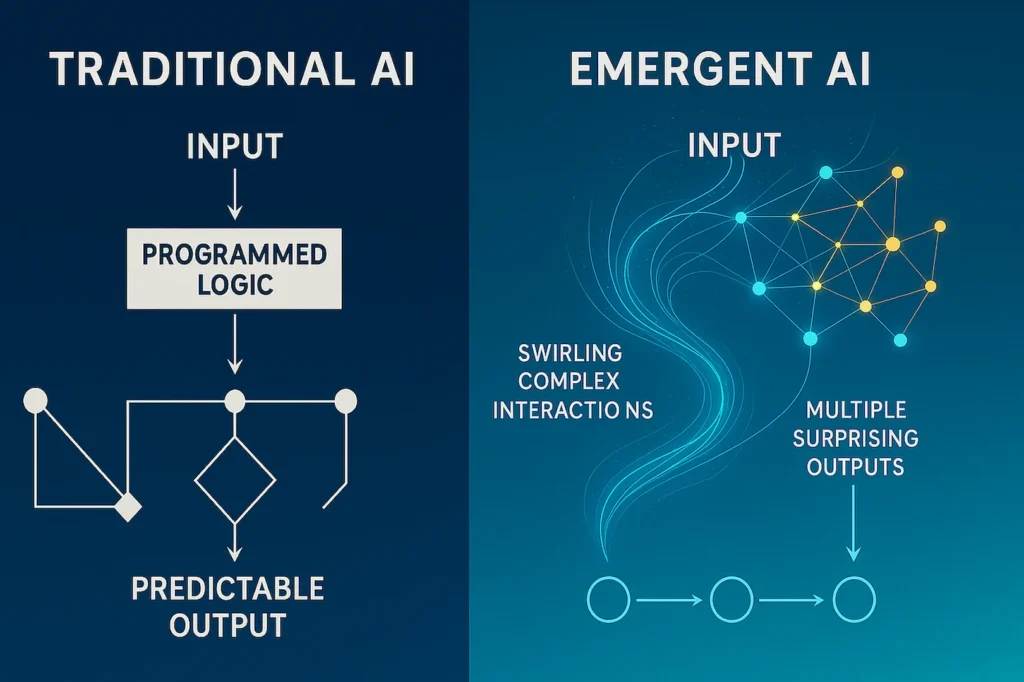
Emergent behavior is often framed as a superior form of AI design—more “alive,” more unpredictable, more advanced. In practice, emergent behavior is not inherently a mark of quality. It is the byproduct of system interaction. And like any outcome, it can enhance or damage gameplay.
Emergent behavior arises when simple rules, combined with environment and player choice, generate unplanned behaviors. This can create moments of surprise and perceived freedom. It can also disrupt pacing, difficulty, and systemic coherence.
Scripted behavior, by contrast, is often unfairly dismissed as outdated or shallow. In reality, scripted AI offers control. It allows designers to precisely define when, how, and why events occur. In systems where pacing, tension, or narrative timing matter, predictability is not a flaw—it is a tool.
The real issue is not choosing one over the other, but balancing them. Emergence adds value when it reinforces the core loop and produces meaningful outcomes. When it creates exploits, nullifies challenges, or destabilizes economy and pacing, it becomes noise.
A mature AI Behavior System understands where freedom is appropriate and where control is necessary. It does not chase unpredictability as an end in itself. It deploys it where it adds depth—and restrains it where it threatens coherence.
When the AI Behavior System Fails
Failures in AI Behavior Systems are rarely spectacular in game design. They do not usually appear as bugs or crashes. They surface as feelings of unfairness, inconsistency, or loss of control—and those are far harder to repair.
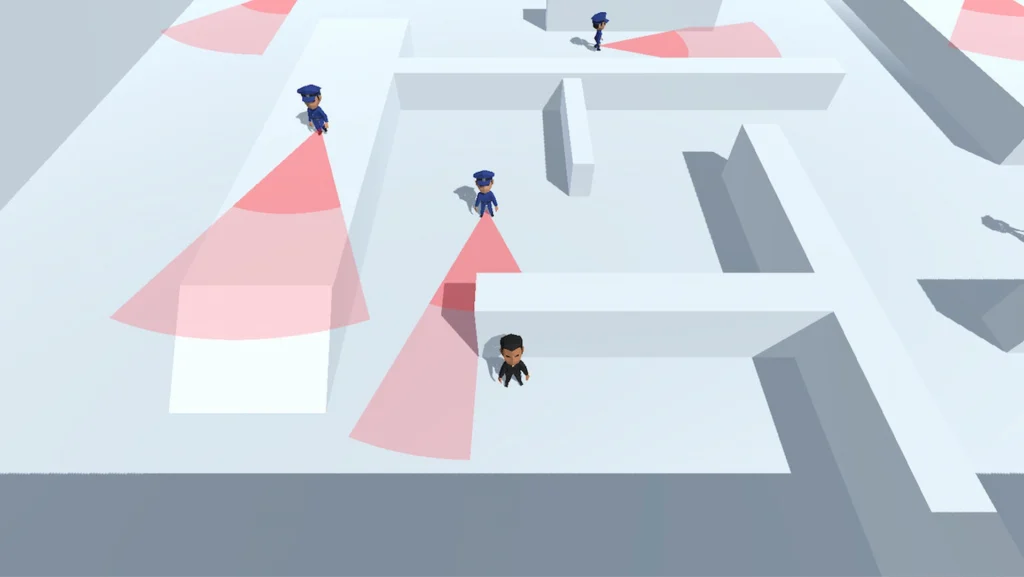
One common failure is AI that “cheats” information. When AI acts on data the player has no access to, behavior feels magical in the worst way. Trust collapses, and learning becomes impossible.
Another is AI that does not play by the same rules. Ignoring constraints that bind the player, bypassing resource systems, or exempting itself from limitations creates asymmetry. Loss no longer feels earned—it feels imposed.
Equally damaging is AI that alters behavior arbitrarily to maintain difficulty. When adaptation lacks visible logic, players cannot incorporate it into strategy. Risk avoidance follows, and meaningful choice disappears.
All these failures share a single outcome: they break the trust relationship between player and game. Once that trust is damaged, no amount of content or mechanical complexity can easily restore it.
AI Decision Logic and Intent Modeling
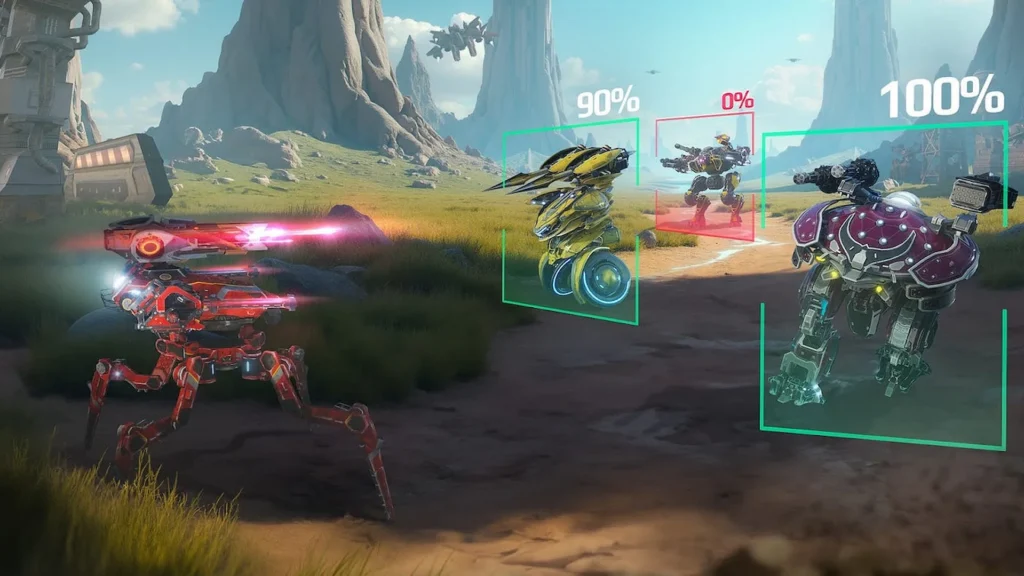
At this point, the discussion shifts from behavior to intent. Reactive rules alone do not produce coherent behavior. AI requires an internal decision logic—even if that logic is never directly exposed to the player.
AI Decision Logic is not about technical implementation. Whether the system uses behavior trees, state machines, or something more complex is irrelevant at the design level. What matters is how goals are prioritized. When the AI presses, retreats, or shifts tactics must follow stable criteria—not momentary balance corrections.
Intent modeling gives AI orientation. Not personality, but purpose. An aggressive AI, a territorial AI, and a support-oriented AI require different decision hierarchies, even if they share tools. Without this differentiation, behavior becomes flat and repetitive.
Risk integration is also critical. AI that always selects the optimal action does not feel intelligent—it feels mechanical. Controlled mistakes, hesitation, and misjudgment create opportunity and perceived vitality. These “errors” are not random. They are designed.
When decision logic is consistent, players begin to understand not just what the AI does, but why it does it. That understanding enables deeper strategic interaction. AI ceases to be a reactive mechanism and becomes part of an ongoing gameplay dialogue.
Behavioral Consistency Across All Game States
Even the most refined decision logic loses value if it fails to remain consistent across the experience. The AI Behavior System must operate across modes, progression stages, and pressure contexts. This is where its quality is truly tested.
Consistency does not mean rigidity. It means logical continuity. As the game shifts from exploration to combat, from early to late game, or from solo to group encounters, AI must evolve without losing its identity. Abrupt, unexplained shifts erode understanding.
A common issue is AI that performs well in isolated scenarios but breaks down when systems intersect. Effective in open spaces, chaotic in enclosed ones. Competent against a single opponent, incoherent in group behavior. These are not minor flaws—they are fractures in systemic cohesion.
Maintaining behavioral identity requires a clearly defined AI role within the game. When that role is clear, adaptation feels natural. When it is not, every change feels arbitrary—and players notice immediately.
Ultimately, consistency across all game states is what allows a game to feel unified. Not as a collection of mechanics, but as an experience with internal logic. That continuity enables AI to function as a reliable conversational partner rather than an unpredictable variable.
The AI Behavior System as a System of Trust and Coherence in game design
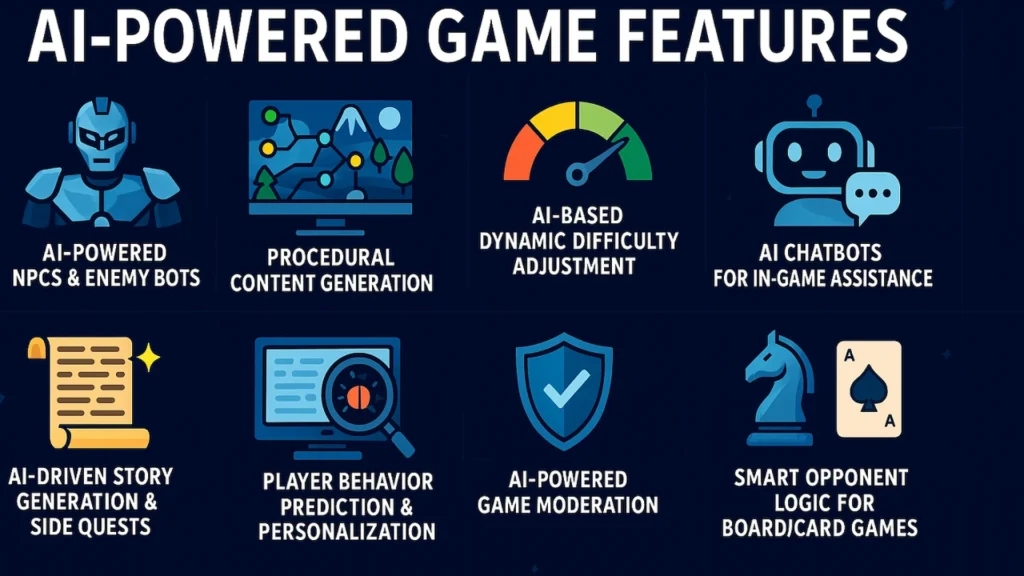
All previous sections describe how the AI Behavior System works. This section explains why it matters. AI is not merely an opponent or challenge mechanism. It is the primary carrier of trust between player and game. Its behavior determines whether the system feels fair, coherent, and reliable.
When AI follows clear rules, makes decisions through recognizable logic, and remains behaviorally consistent across game states, players feel they are engaging with a system they can understand. They do not need to agree with every outcome. They need to understand how it occurred. That understanding is the foundation of trust.
When this fails, even technically sound systems feel artificial. Combat becomes unpredictable. Difficulty feels arbitrary. Economy disconnects from player choice. AI is where these inconsistencies converge and become visible.
Ultimately, the AI Behavior System is the connective tissue of the Systems & Mechanics pillar. It translates rules into action, numbers into pressure, and choices into consequences. Without it, systems exist—but they do not communicate.
Well-designed AI does not aim to impress. It aims to support coherence. To make the game feel honest, readable, and meaningful. When that happens, players do not talk about the AI as a separate feature. They talk about the experience as a whole.
Conclusion
The AI Behavior System is one of those design components that rarely draw attention when they work—but immediately expose themselves when they fail. It is not a spectacle system, nor a demonstration of technical prowess. It is the mechanism that determines whether all other systems can coexist with coherence and meaning.
As shown throughout this analysis, AI is not defined by how “smart” it appears, but by how understandable, consistent, and reliable it is. From behavioral readability and decision logic to pressure regulation and systemic consistency, AI shapes how players perceive the game itself.
Within the Systems & Mechanics pillar, the AI Behavior System does not sit alongside combat and economy—it connects them. It activates them. It exposes them. When properly designed, it reinforces learning, challenge, and trust. When it fails, it undermines everything built around it.
If there is one takeaway worth retaining, it is this: AI does not exist to defeat the player. It exists to help the player understand the system they are playing within. And when that happens, the experience moves beyond functionality. It becomes coherent, fair, and meaningful.