
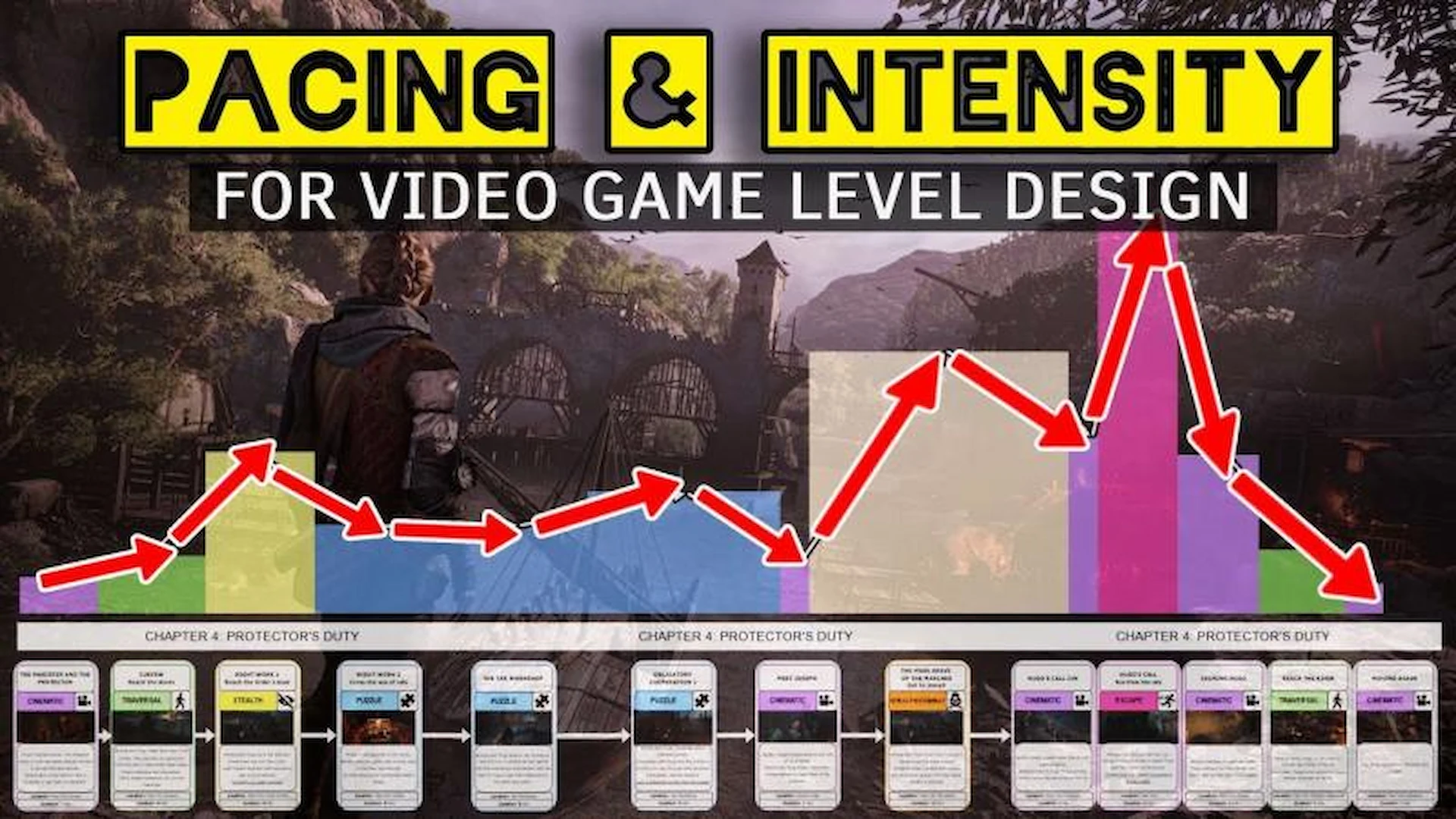
In game design, pacing is not a narrative luxury nor a matter of aesthetics. It is a structural parameter that determines whether a gameplay loop can function long-term without collapsing under fatigue or indifference. Downtime vs Intensity is the design component that regulates this dynamic within a game. It defines when the game pressures the player and when it allows them to breathe, process information, and reposition themselves within the system.
Unlike components such as Player Actions or Primary Objectives, which define what the player does, Downtime vs Intensity defines how the player experiences those actions over time. It is the mechanism that transforms a set of systems into an experience with rhythm, escalation, and sustainability. Within the framework of the 9 core pillars of game design, it operates as a pressure regulator between mechanical complexity, cognitive load, and emotional engagement.
The Concept of Intensity in Gameplay
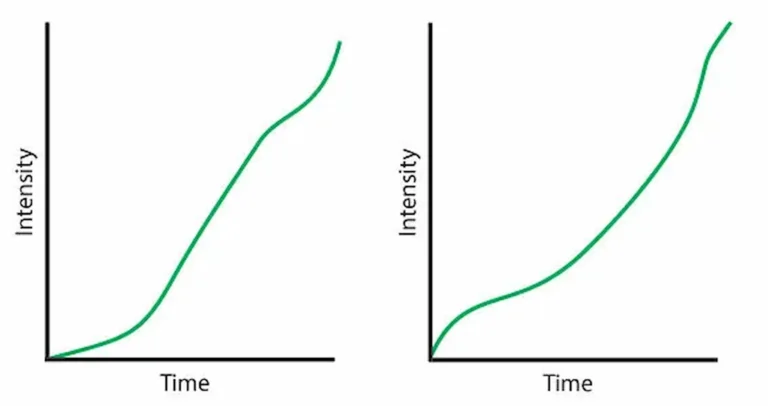
Intensity in gameplay is not synonymous with action, speed, or genre. It results from the simultaneous activation of mechanical demands, cognitive load, and consequences of failure. A game enters a high-intensity state when the player must make decisions under time pressure, with high risk and immediate consequences affecting Primary Objectives or overall progression.
Intensity emerges from the relationship between Player Actions and Fail States. When actions require precision, timing, or irreversible decisions, and when failure carries real cost, the system generates intensity regardless of whether gameplay is real-time or turn-based. Intensity, therefore, is not genre-dependent. It is a product of design.
The Concept and Function of Downtime
Downtime is the temporal and systemic period where pressure is intentionally reduced. It is neither passive time nor filler content. It is an active processing space in which the player can think, analyze, plan, and connect individual experiences into a broader context.
During downtime, Fail States are either absent or carry limited consequences, Player Actions do not require immediate execution, and Primary Objectives do not impose urgent pressure. This allows players to understand systems, absorb rewards, and prepare for the next phase of intensity. When downtime is missing or poorly designed, the game either exhausts the player or leaves them disengaged.
Downtime vs Intensity in game design as a Regulation Mechanism of the Core Gameplay Loop
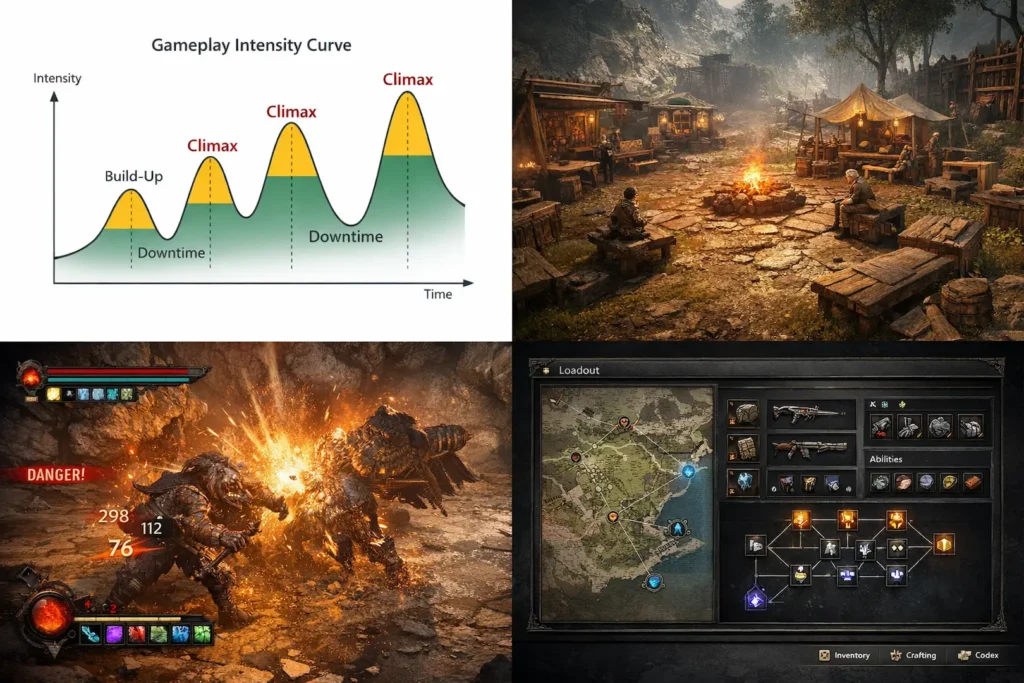
The Core Gameplay Loop is neither static nor linear. It functions as a repeating pattern with alternating phases of pressure and relief. Downtime and Intensity determine when the loop peaks and when it slows down. Without this alternation, the loop loses its dynamic character.
Intensity gives meaning to effort and makes the Reward Cycle meaningful. Downtime allows rewards to be perceived, evaluated, and integrated into the player’s strategy. If everything is intense, rewards lose significance. If everything is downtime, progression feels lifeless.
System-Driven vs Player-Driven Downtime
Downtime is not a uniform phenomenon. At the core of design, it separates into system-driven and player-driven forms, and this distinction is critical for controlling the experience.
System-driven downtime is imposed by the game itself. It arises from safe zones, menus, hub areas, preparation phases, or transitions where the system deliberately reduces intensity and limits the activation of Fail States. In these cases, the designer maintains full control over pacing and determines when players are allowed to decompress.
Player-driven downtime, on the other hand, emerges from choice. It occurs when players decide to step back from the core loop, delay progression, experiment, or reassess strategy without system enforcement. This form of downtime is directly linked to player agency and strengthens engagement with Long-Term Loops by allowing players to control their own pacing.
Effective design does not rely exclusively on one form. When downtime is purely system-driven, the game becomes rigid and predictable. When it is only player-driven, the system loses control over intensity. Downtime vs Intensity functions correctly only when both forms coexist and complement each other.
Relationship with Player Actions
Intensity escalates when Player Actions are time-constrained, require precision, or carry irreversible consequences. Downtime, in contrast, allows low-risk actions, experimentation, and preparation. The deliberate alternation between these states is crucial.
One of the most common design mistakes is the constant availability of all actions without variation in intensity. When players can always do everything in the same way, the system loses its ability to generate meaning through risk and choice.
Relationship with Primary Objectives
During high-intensity phases, Primary Objectives must be clear and immediate. Players lack cognitive space to redefine goals or evaluate long-term strategies. Downtime, by contrast, is the moment when players connect short-term achievements with long-term direction.
When a game demands strategic thinking during intense moments or provides downtime disconnected from objectives, inconsistency emerges. Downtime and Intensity act as filters determining which level of objectives is active at any given time.
Relationship with the Reward Cycle
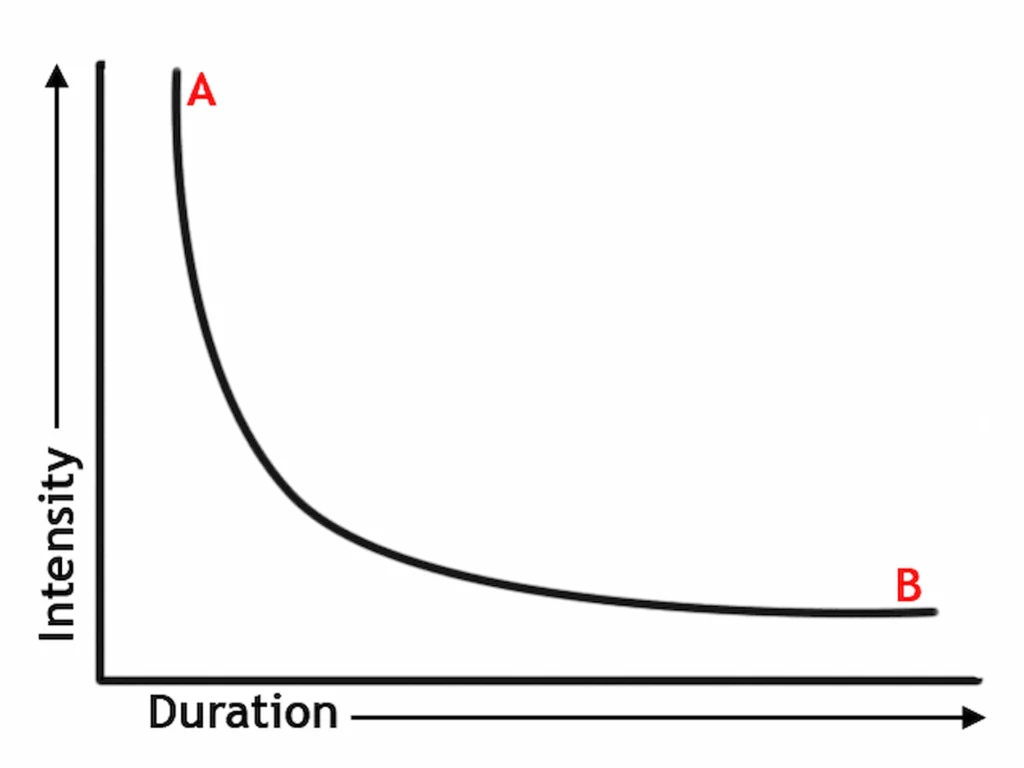
The Reward Cycle gains value only when preceded by intensity. Rewards following pressure function both emotionally and mechanically. Downtime is the stage where players understand rewards, evaluate usefulness, and integrate them into the next decision cycle.
Continuous rewards without intensity lead to devaluation. Conversely, constant intensity without downtime undermines the sense of achievement. Rhythm design is what keeps the reward cycle alive.
Relationship with Fail States
Fail States are the primary drivers of intensity. The greater the cost of failure, the higher the tension. Downtime allows controlled failure, learning, and adaptation without punitive pressure.
Good design does not eliminate failure but defines when failure acts as a lesson and when it acts as a threat. Downtime and Intensity determine this transition and directly influence the player’s willingness to take risks.
Relationship with Repetition Cadence
Repetition without variation in intensity leads to mechanical fatigue. Downtime acts as a relief point before repetition becomes exhausting. At the same time, increasing intensity once players master a pattern maintains engagement.
Downtime and Intensity are the mechanisms that allow repetition cadence to remain functional rather than tiring.
Relationship with Short-Term and Long-Term Loops
Short-Term Loops draw strength from intensity. Long-Term Loops require downtime to become perceptible and meaningful. Without downtime, long-term progression becomes invisible. Without intensity, short-term experience becomes flat.
This component acts as the bridge allowing short-term and long-term loops to coexist without canceling each other out.
Cognitive Load and Player Endurance
Intensity increases cognitive load. Downtime enables cognitive recovery and knowledge consolidation. In systems-heavy games, this is not optional but necessary. Without controlled downtime, the learning curve collapses and the game becomes hostile.
Long-Term Escalation of Intensity and Rhythm (Macro Pacing)
Downtime vs Intensity in game design does not operate only at a micro level within encounters or loops. It also functions at a macro scale, shaping the pacing of the entire game from beginning to end.
In early stages, downtime is frequent and protective, allowing players to understand Player Actions, Fail States, and the Reward Cycle without excessive pressure. Intensity appears in controlled doses with clear Primary Objectives.
As the game progresses, intensity increases not necessarily because systems become more violent, but because they interact more deeply. Downtime does not disappear but transforms. It shifts from educational to strategic, from safe to selective. In late stages, downtime is often not freely offered but earned or created through correct decisions.
If designers ignore this long-term escalation, the result is a game that either loses momentum after mid-game or collapses under overload. Macro pacing demonstrates that Downtime vs Intensity is not a momentary tool but a structural parameter of the entire experience.
Downtime, Intensity, and Player Mastery
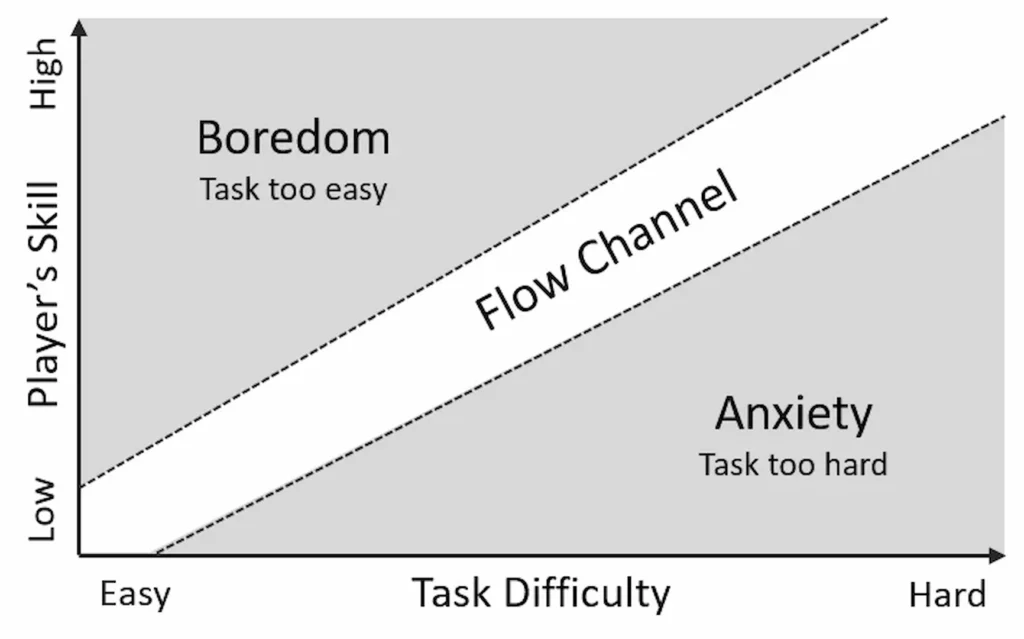
As players gain mastery, the same mechanics generate less intensity. This is not a problem but a natural consequence of learning. The design issue arises when the game fails to respond to this change. If Downtime vs Intensity remains static, the experience loses impact.
The designer’s role is to recognize that intensity decreases not because the game became easier, but because the player became more capable. To maintain balance, the system must redefine when and how pressure is applied. This can occur through more complex system interactions, stricter Fail States, or limiting downtime at critical points.
At the same time, downtime gains a new function. It no longer serves learning but strategic reorganization and preparation for larger-scale decisions. In this way, Downtime vs Intensity remains an active design component throughout the entire game and does not become an outdated tutorial artifact.
Conclusion
Downtime vs Intensity is a fundamental design component that determines whether a game can sustain rhythm, cohesion, and long-term endurance. It is not about genre, audience, or style. It is about structure.
Combined with Player Actions, Primary Objectives, Reward Cycles, Fail States, Repetition Cadence, and the distinction between Short-Term and Long-Term Loops, it forms a core element of the architectural framework described within the 9 pillars of game design.
When gameplay “doesn’t click,” the problem often does not lie in the systems themselves, but in the rhythm through which players are asked to experience them. And that is purely a matter of Downtime vs Intensity.