
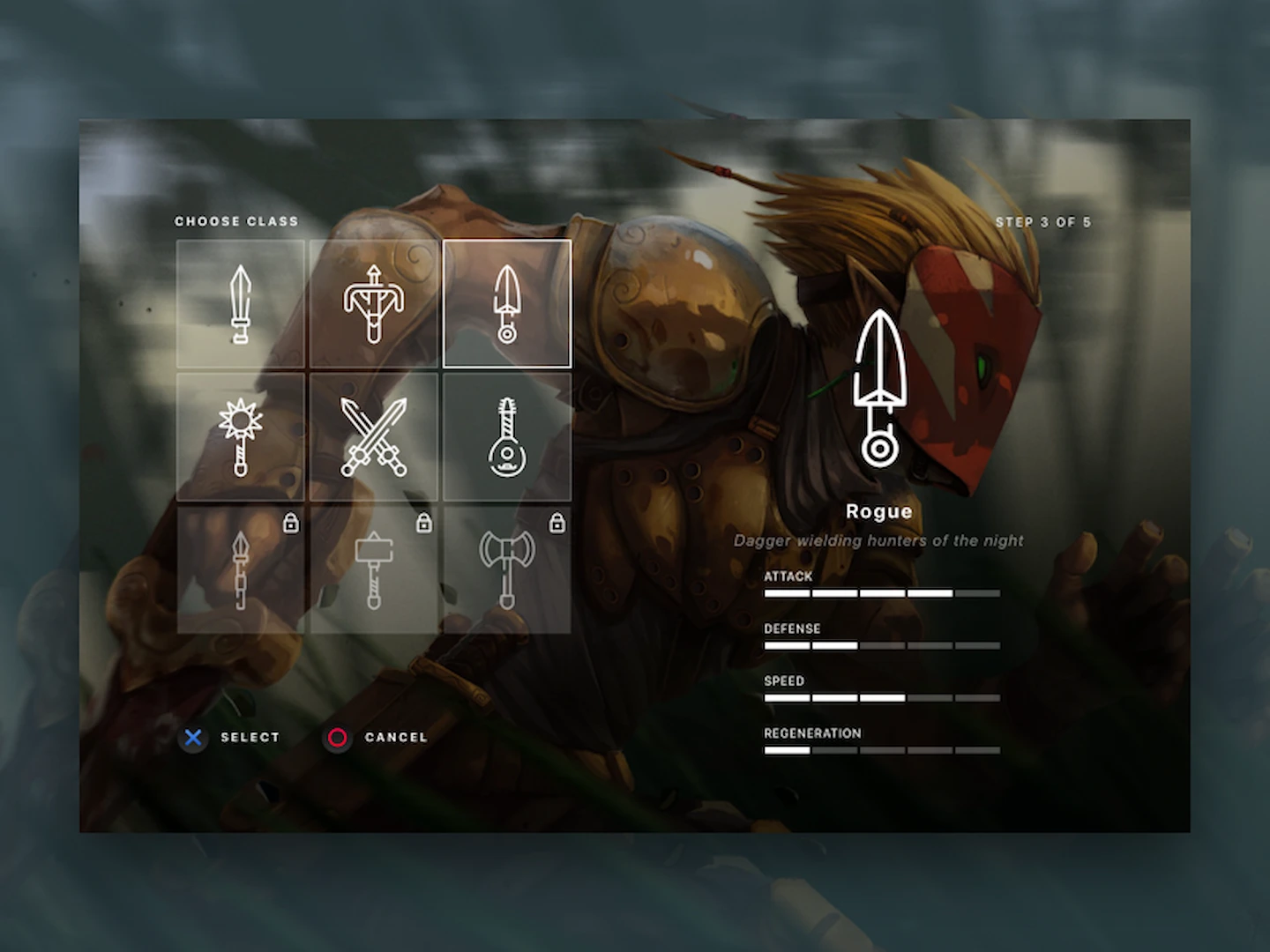
Within the Player Agency & Control pillar, the discussion does not revolve simply around whether players are offered choices, but whether those choices are real, understandable, and systemically supported. Build / Playstyle Ownership stands as one of the most critical components of this pillar in game design, because it represents the point where player decisions stop being abstract and begin to materialize directly in gameplay.
Unlike components tied to moment-to-moment decision making, Build / Playstyle Ownership concerns duration, commitment, and consistency. It examines whether a game allows players to shape a playstyle that genuinely belongs to them, and whether systems respect that shaping over time instead of invalidating it through balance changes, meta pressure, or design shortcuts.
This article is part of the analytical breakdown of the Player Agency & Control pillar presented in the main article on the Nine Core Pillars of Game Design. The goal here is not to catalogue builds or archetypes, but to technically analyze the systems that determine whether a build and a playstyle can truly be considered player ownership, or merely variations within a predetermined design path.
What Build / Playstyle Ownership Really Means in Game Design
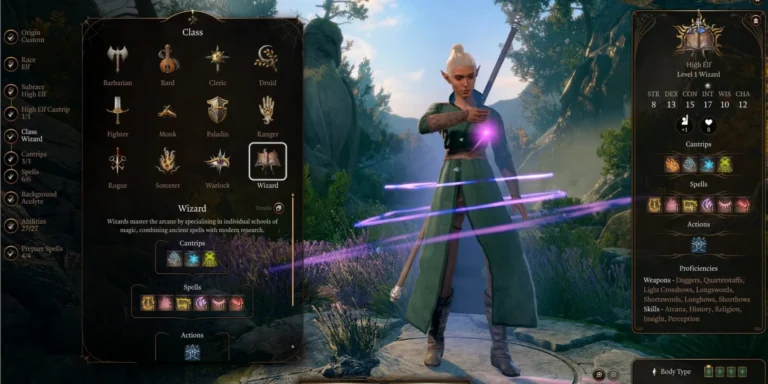
Build / Playstyle Ownership is one of the most misunderstood yet essential mechanisms in both game design and the Player Agency & Control pillar. It does not simply refer to the existence of different builds or equipment options. It concerns whether the game allows players to feel that their way of playing emerges from conscious decisions rather than from preset paths, hidden optimizations, or systemic design coercion.
At a technical level, ownership is not an emotional concept. It is the result of system-level structures: how stats are defined, how they scale, how they interact, how much deviation they allow, and whether the game recognizes and sustains player choices in practice rather than undermining them.
Build vs Playstyle: A Necessary Technical Distinction
A critical first step is distinguishing between build and playstyle.
A build refers to the structural configuration of a character at the system level, including stats, skills, perks, equipment, modifiers, and scaling rules. Playstyle refers to how these tools are executed under real gameplay conditions: tempo, positioning, risk management, target prioritization, and timing.
A game may offer dozens of builds but only a few actual playstyles. This happens when different numerical configurations ultimately produce identical behaviors within the combat or core gameplay loop. In such cases, the system offers apparent variety without true ownership.
The opposite problem can also occur. A game may encourage different playstyles through skill expression but structurally punish players who do not follow the “correct” build. In that case, ownership erodes under meta pressure and balance asymmetry.
Ownership as a Result of Systemic Coherence
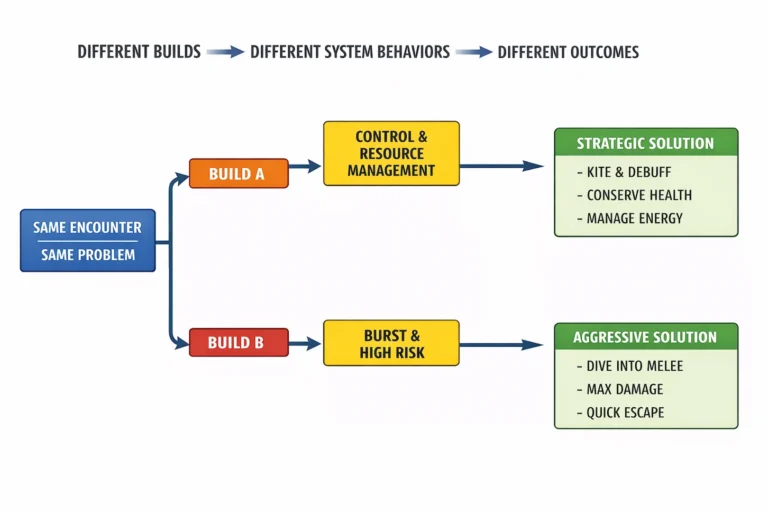
Build / Playstyle Ownership does not emerge from UI options. It emerges when systems cooperate instead of undermining each other.
Every choice given to the player must carry predictable, but not entirely safe, consequences. If a choice is always correct or always wrong, it is not a choice but a design trap.
At the systems level, ownership emerges when:
- Player investments persist over time and are not arbitrarily invalidated by mid-game redesigns, sudden difficulty spikes, or internal balance shifts.
- The game recognizes builds not only numerically but functionally. Different builds must change how players approach problems, not merely how long they need to solve them.
- The system allows deviation from optimal solutions without collapsing. When only one build remains viable at higher levels, ownership becomes an illusion.
Stat Architecture and the Illusion of Choice
Stat architecture is decisive. In many games, stat systems mathematically converge toward specific solutions. Soft caps, diminishing returns, and hidden breakpoints often guide players—consciously or not—toward predetermined builds.
This is not inherently wrong. It becomes problematic when the game fails to communicate these structures clearly and allows players to believe they are crafting something unique while actually following the only viable curve.
Ownership requires stats to function as tools that shape behavior. A stat that merely increases damage without altering decision making does not support playstyle. Stats affecting tempo, resource pressure, recovery windows, or risk tolerance, on the other hand, meaningfully reinforce ownership.
Skills, Perks, and the Question of Reversibility
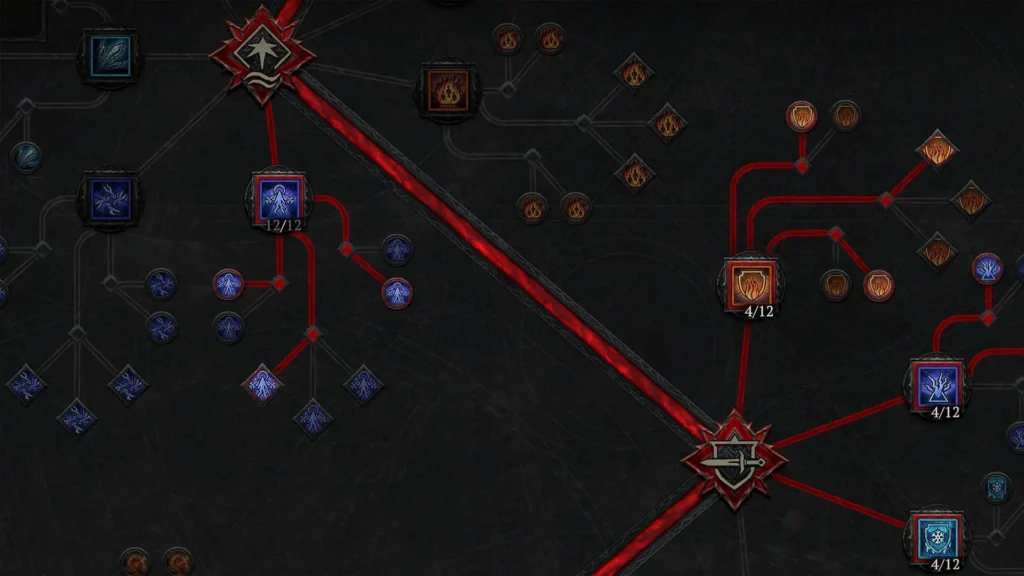
Respec systems present one of the most delicate design challenges.
Total freedom to respec reduces the weight of decisions. Complete absence of respec leads to fear-driven play and external optimization through guides.
Build / Playstyle Ownership works best when choices carry cost without becoming destructive. Partial reversibility, economic or temporal limitations, and gradual commitment systems create responsibility without punishing experimentation.
Equally important is that skills and perks do not function in isolation. When synergies are obvious or superficial, builds turn into checklists. When interactions create emergent behaviors, playstyles develop personality.
Balance, Meta, and Systemic Erosion of Ownership
No build exists in isolation. Meta pressure—whether in single-player or multiplayer environments—inevitably shapes behavior. When balance allows one build to outperform all others across contexts, ownership collapses.
At a technical level, this happens when:
- Scaling disproportionately favors specific options.
- Encounters fail to test different competence axes.
- Risk-reward ratios differ drastically across playstyles.
A game should create situations where different builds excel under different circumstances. The goal is not equality of outcomes, but equivalence of viability.
Feedback, Readability, and Recognition of Playstyle
Ownership strengthens when the game actively recognizes how players play.
This extends beyond achievements or flavor text. It involves feedback loops that confirm the system “understands” player choices.
Audio-visual cues, animation priorities, AI reactions, and even level design can reinforce playstyle identity. When the game responds differently to a ranged control character compared to a high-risk melee character, the build stops being abstract and becomes embodied in play.
Relationship with Other Player Agency & Control Components
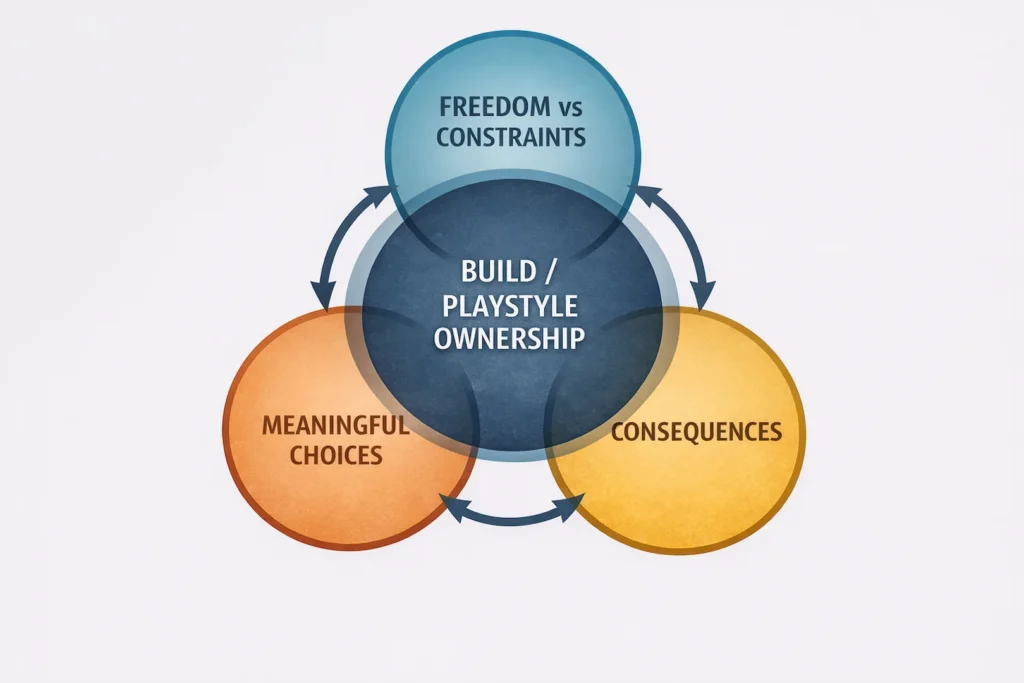
Build / Playstyle Ownership cannot exist in isolation. Ownership arises only when builds operate within clear constraints, are supported by meaningful choices, and are tied to real consequences.
Without constraints, builds lose purpose because nothing tests or differentiates them. When everything is allowed, nothing carries weight.
Without meaningful choices, builds become cosmetic variations. Choices become decorative when they fail to alter how the system responds to player actions.
Without consequences, ownership dissolves. A build that can change freely, faces no risk, and does not shape future experience becomes a temporary configuration rather than a gameplay identity.
For designers, this means ownership is not a standalone feature. It emerges when choices, constraints, and consequences operate coherently without undermining one another.
Build / Playstyle Ownership as a Sign of Mature Design
Build / Playstyle Ownership is a marker of design maturity. It does not appear in the first playthrough, nor does it impress in trailers. It becomes visible when players can describe how they play without referring to numbers—when they can say, “this is how I play,” and the game does not contradict them.
For designers, this means focusing less on sheer option quantity and more on systemic consistency. Ownership cannot be directly designed. It emerges when everything else works as intended.