
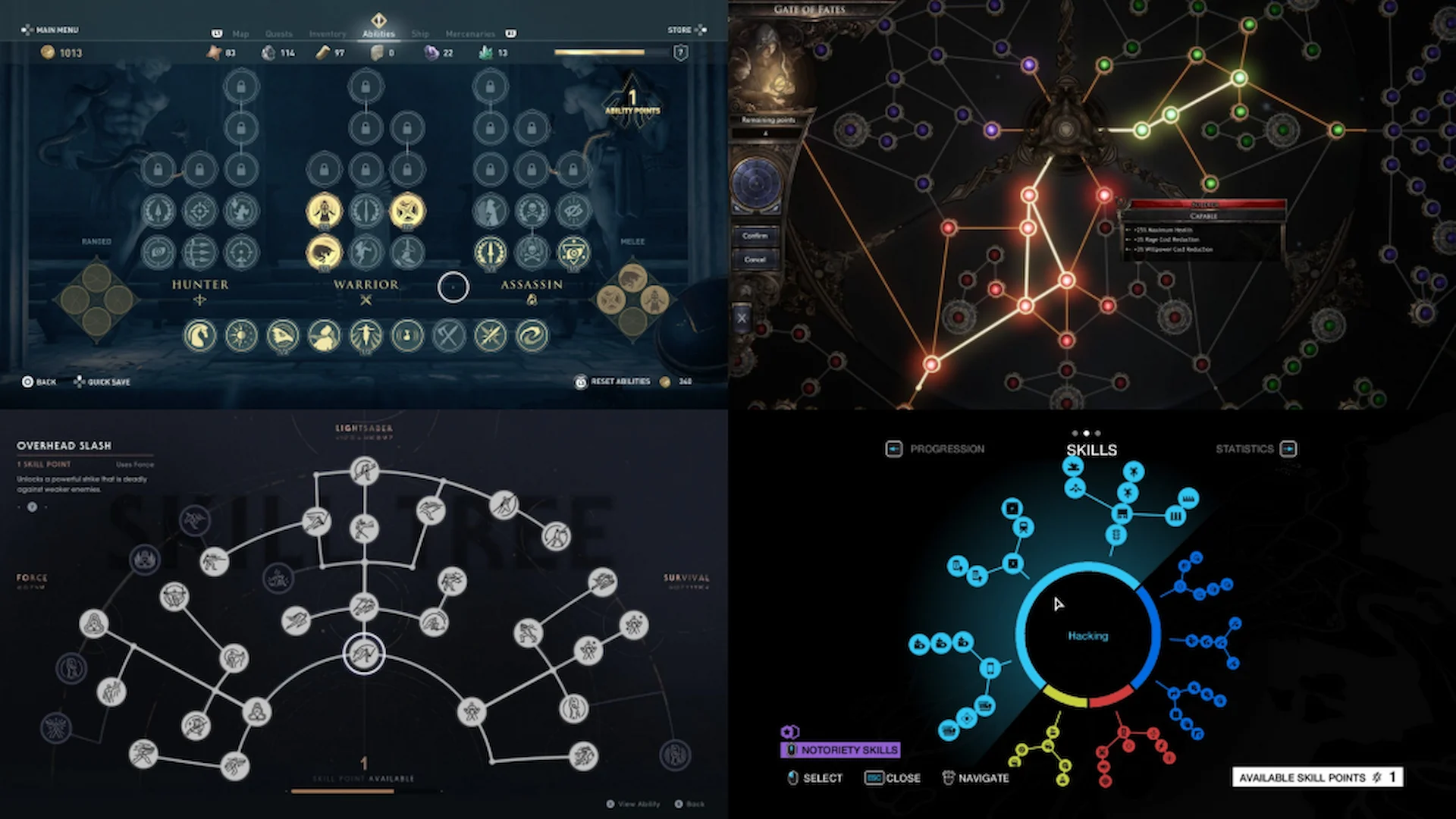
In modern game design, skill trees are often treated as a usability problem. Too complex, too punishing, too demanding for onboarding. The common response has been simplification, modular perks, or complete removal in favor of flexible progression systems.
In practice, this shift is not neutral. It fundamentally alters how player agency, identity, and long-term engagement are constructed.
Simplification does not merely reduce complexity. It redistributes responsibility.
Skill Trees as Commitment Systems
Traditional skill trees functioned as commitment structures. They forced players to make decisions with incomplete information, accept trade-offs, and live with the consequences of their choices. The resulting build was not just a configuration. It was a trajectory.
This commitment created identity. Two players of the same class could inhabit radically different playstyles, rhythms, and risk profiles. The system did not merely enable variation. It enforced differentiation.
When progression systems remove or soften commitment, they also weaken the link between choice and consequence.
Accessibility Versus Agency
Modern progression systems often prioritize approachability. Easy respecs, flat trees, and interchangeable perks reduce friction and protect players from irreversible mistakes. This improves onboarding and lowers early abandonment.
However, reduced friction comes with reduced ownership.
When every choice is reversible, decisions lose weight. When builds can be corrected instantly, experimentation becomes optimization. Agency remains present, but responsibility diminishes.
The player is empowered to adjust, but less encouraged to commit.
Build Diversity and Player Convergence
One overlooked side effect of simplified progression is player convergence. When systems limit meaningful divergence, players of the same class begin to resemble one another mechanically, even if surface customization remains.
This convergence is not a failure of player creativity. It is a structural outcome. Systems that minimize trade-offs naturally compress variation.
In contrast, commitment-based systems produce divergence through constraint. Differences emerge not because players want to be unique, but because they are forced to choose what to sacrifice.
When Skill Trees Fail
Skill trees are not universally appropriate. In games where core mechanics rely on reflex, flow, or narrative pacing, traditional trees can become redundant or obstructive. In these contexts, progression often functions better as gradual capability unlocking rather than identity definition.
The issue is not the presence of a skill tree, but whether it meaningfully alters player behavior. If progression only increases efficiency without changing decisions, the system adds complexity without expression.
Design Implications
The removal or simplification of skill trees should be treated as a design decision with explicit trade-offs, not a default usability fix. Effective design evaluation requires system-level analysis rather than surface-level iteration.
Effective design evaluation should consider:
- Whether progression decisions meaningfully affect playstyle.
- Whether the system enforces trade-offs or merely offers rearrangement.
- How commitment, or its absence, impacts player identity over time.
- If removed systems are replaced by alternative mechanisms for expression.
- Without this evaluation, simplification risks eroding depth under the guise of accessibility.
Takeaway
Skill trees did not disappear because they were ineffective. They were softened because modern design increasingly avoids asking players to commit.
- Accessibility improves reach. Flexibility reduces frustration. But identity, differentiation, and long-term ownership emerge from constraint.
- Progression systems do not lose depth when they become simpler. They lose depth when they stop demanding responsibility.
The question is not whether a game should have a skill tree.
The question is whether the design is willing to ask the player to choose—and accept the cost of that choice.